Product Description
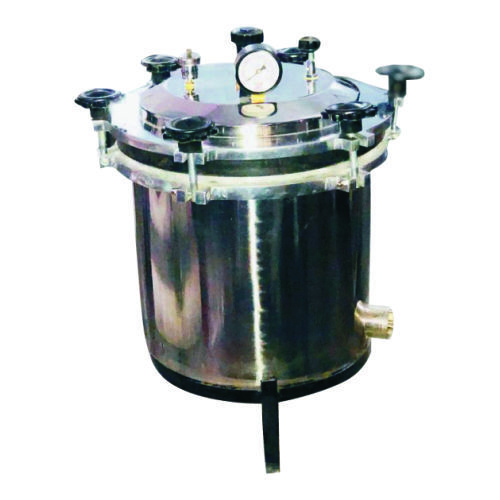
All body made of StainlessSteel or Aluminum.
To work on 220/330Volt ACSupply
Stainless Steel Aluminum Body Capacity
300 x 300 300x 300 20Litres
300 x 375 300x 375 25Litres
300 x 450 30Litres
300 x 500 40Litres
Superior Material and Construction QualityThe autoclave's chamber and major components are fabricated from high-grade Stainless Steel 304, ensuring resilience against corrosion, thermal shock, and frequent use. The double-walled insulation with mineral wool filling provides efficient heat retention while the polished exterior enhances longevity. The seamless stainless-steel piping system adds further durability and operational reliability, making maintenance effortless.
Efficient Sterilization and User-Friendly OperationOur autoclave provides exceptional sterilization at 121C to 126C, accommodating various laboratory and clinical requirements. The manual control system, complete with a clear pressure gauge and indicator lamp, allows users to tailor the process easily. Features such as the automatic pressure cut-off ensure safe operation while the pressure-tight lid with wing nut locking system guarantees leak-proof performance.
Flexible and Safe for Multiple ApplicationsSuitable for laboratory, clinic, and hospital use, this autoclave is ideal for sterilizing instruments, glassware, and textiles. The insulated, heat-resistant handles allow safe handling, and its portability makes it convenient for a variety of workspaces. Integrated safety valves and pressure release mechanisms further enhance protection for both the operator and the equipment.
FAQ's of Portable Autoclave:
Q: How do I operate the portable autoclave for effective sterilization?
A: To operate the autoclave, first load instruments into the removable stainless-steel basket and ensure the water level is adequate using the indicator. Close the pressure-tight lid securely with the wing nut locking system. Set the required temperature (121C) and monitor the process with the manual controls and pressure gauge. The autoclave automatically maintains the working pressure and activates the safety pressure cut-off if needed. Typical sterilization cycles last 15-30 minutes.
Q: What are the benefits of using Stainless Steel 304 construction in this autoclave?
A: Stainless Steel 304 offers high resistance to rust, corrosion, and chemical damage, ensuring the autoclave remains durable and hygienic even after repeated use. Its polished finish also allows for easy cleaning and maintenance, supporting long-term, reliable performance in diverse medical and laboratory environments.
Q: When should I use this portable autoclave, and for what applications is it suitable?
A: This portable autoclave is best used whenever sterilization of laboratory, clinical, or hospital instruments and materials is required. It is suitable for sterilizing surgical tools, laboratory glassware, and dressings. Its compact design allows it to be used in varied settings, offering flexibility for on-site sterilization wherever necessary.
Q: Where can the portable autoclave be placed for optimal operation?
A: The autoclave should be placed on a stable and heat-resistant surface with adequate ventilation. Ensure it is positioned near a suitable electrical outlet (230V AC, 50 Hz) and away from water sources. Its portability enables easy relocation within laboratories, clinics, or hospital departments as needed.
Q: What process does the autoclave follow to sterilize equipment?
A: Once loaded, the autoclave heats water to generate saturated steam, raising the temperature to 121C under 1.2 kg/cm2 pressure. The uniform heat and pressure are maintained for 15-30 minutes, effectively destroying microorganisms. The manual monitoring system allows users to supervise temperature, pressure, and cycle time, ensuring complete sterilization.
Q: How does the autoclave ensure uniform heat distribution and operator safety?
A: The double-walled construction with mineral wool insulation as well as the ISI marked heating element guarantee uniform temperature throughout the chamber. Safety is reinforced through mechanisms such as automatic pressure cut-off, safety and pressure release valves, and insulated, heat-resistant handles to protect users during the operation.







 English
 Spanish
 French
 German
 Italian
 Chinese (Simplified)
 Japanese
 Korean
 Arabic
 Portuguese


 Send Inquiry

