Product Description
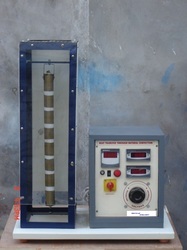
The setup consists of a brass tube fitted in a rectangular duct in a vertical fashion. The duct is open at the top and bottom, and forms an enclosure and serves the purpose of undisturbed surrounding. One side of the duct is fitted with a transparent good quality Acrylic window for visualization. An electric heating element is kept in the vertical tube that in turns heats the tube surface. The heat is lost from the tube to the surrounding air by natural convection. The temperature of the vertical tube is measure by Temperature Sensors and displayed by a Digital Temperature Indicator with multi-channel switch. The heat input to the heater is measured by a Digital Ammeter and a Digital Voltmeter and is varied by a variac. The tube surface is polished to minimize the radiation losses.
Experiment
- To determine average heat transfer coefficient
Utilities Required
- Electricity Supply: I Phase, 220 V AC, 2 Amp.
- Table for set-up support
Comprehensive Laboratory ToolThis natural convection apparatus is ideal for studying real-life heat transfer processes in laboratory environments. Its stainless steel construction enhances durability while the broad voltage compatibility ensures adaptability. Users can observe and analyze the principles of natural convection through controlled experiments across a 30-80C temperature window, supporting both fundamental and applied research.
Robust Stainless Steel BuildBuilt from high-grade stainless steel, the equipment resists corrosion and extends longevity even under rigorous lab usage. Its manageable weight (1-10 kg) allows for convenient movement and setup, making it suitable for both academic and industrial training laboratories.
Flexible Temperature and Voltage OptionsWith an operating voltage range of 110-220V, this device can be used in a variety of global laboratory settings without hassle. The adjustable temperature settings (30-80C) cater to diverse experimental needs, providing ample flexibility for different applications in thermal studies.
FAQ's of Heat Transfer In Natural Convection:
Q: How does the Heat Transfer in Natural Convection apparatus operate in a laboratory setting?
A: This apparatus demonstrates heat transfer by natural convection, where heat is transferred from a heated plate to surrounding air without the aid of forced movement. It allows users to monitor temperature changes and study heat transfer rates within a 30-80C range, providing practical insights into convection processes.
Q: What are the benefits of using stainless steel for this equipment?
A: Stainless steel offers high durability, excellent heat resistance, and corrosion protection, ensuring the equipment remains reliable even with frequent laboratory usage. This material choice also facilitates easy cleaning and maintenance, supporting long-term educational or research goals.
Q: When should this natural convection unit be used in a laboratory?
A: It is ideal for experiments related to thermodynamics and heat transfer, especially when studying the principles of natural convection. Use this equipment during lab courses, research projects, or training sessions that require precise and observable heat transfer experiments.
Q: Where is this Heat Transfer in Natural Convection apparatus manufactured and distributed?
A: This product is designed, manufactured, supplied, and exported by a leading company based in India, catering to the needs of laboratories and institutions both domestically and internationally.
Q: What is the process for setting up and using the device in experiments?
A: To set up, connect the apparatus to a power source (110-220V), set the desired temperature within the 30-80C range, and allow the system to stabilize. Observations and measurements can then be conducted as heat transfer occurs naturally within the device's chamber or plate area.
Q: Can this apparatus be easily moved or integrated into existing lab setups?
A: Yes, it weighs between 1-10 kilograms, making it lightweight and easy to transport or reposition as needed. Its compact build ensures it fits smoothly in most laboratory environments without requiring specialized setup.







 English
 Spanish
 French
 German
 Italian
 Chinese (Simplified)
 Japanese
 Korean
 Arabic
 Portuguese



 Send Inquiry

