Product Description
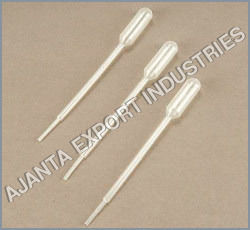
Features- These unbreakable, non toxic all-in-one pipettes eliminate the hazard of broken glass and exposure to infectious material.
- Molded from translucent low-density polyethylene they are inert to biological fluids and most acids.
- Can be sealed and refrigerated.
- The low-affinity surface reduces the loss of cell & valuable proteins due to binding.
- Sterile and non sterile options available.
Pasteur Pipettes, LDPE| Code | Capacity (ml) | Length (mm) | No. Per Case |
| P31201 | 1.0 | 150 | 500 |
| P31202 | 1.0 (Sterile) | 150 | 500 |
| P31205 | 3.0 | 155 | 500 |
| P31206 | 3.0 (Sterile) | 155 | 500 |
Durable and Precise Laboratory PipettesConstructed from high-quality LDPE, these Pasteur Pipettes offer reliability and precision in laboratory liquid handling. The fine-tip ensures precise dispensing, while optional graduation marks facilitate approximate volume measurement. Their unbreakable, disposable design ensures safe usage and minimizes contamination risks, making them ideal for demanding lab environments.
Safe, Convenient, and Versatile UsageOffered as sterile or non-sterile, each pipette meets strict safety standards and comes packaged to suit different workflow needs-either in bulk bags or individually wrapped. The PVC-free and odorless construction guarantees a safe laboratory experience. With resistance to mild acids and bases, these pipettes suit various scientific purposes, including microbiology, sample dispensing, and general liquid transfers.
Designed for Ease of Use and EfficiencyLightweight and easy to handle, these pipettes are intended for single use, reducing the hassle of cleaning or risk of cross-contamination. Their transparent, ergonomic shape aids visual monitoring of samples, and their manual operation offers flexibility in laboratory routines. With speeds dictated by user handling, they offer accuracy within 5% for general purposes.
FAQ's of Pasteur Pipettes, LDPE:
Q: How are Pasteur Pipettes used in laboratory settings?
A: Pasteur Pipettes are commonly used for transferring, mixing, or dispensing small quantities of liquids in laboratory applications such as microbiology, serology, and sample handling. The fine tip facilitates precise liquid transfer, while the transparent body allows visual monitoring during use.
Q: What are the benefits of using LDPE Pasteur Pipettes with graduation marks?
A: Graduation marks on LDPE Pasteur Pipettes enable approximate volume measurements, aiding in accurate and consistent liquid transfers. The LDPE construction makes them unbreakable, lightweight, and resistant to mild acids and bases, enhancing usability and safety.
Q: When should I choose sterile vs. non-sterile Pasteur Pipettes?
A: Sterile pipettes are recommended when working in environments requiring contamination-free handling, such as clinical or microbiology labs dealing with sensitive samples. Non-sterile versions are suitable for less critical procedures or routine laboratory tasks.
Q: Where are these Pasteur Pipettes manufactured and supplied?
A: These Pasteur Pipettes are manufactured, supplied, and exported by distributors and traders in India, catering to laboratories and research facilities both locally and internationally.
Q: What is the process for disposing of these pipettes after use?
A: As these pipettes are designed for single use, they should be disposed of according to laboratory biohazard or chemical waste guidelines after use, helping to prevent cross-contamination and ensure laboratory hygiene.
Q: Can Pasteur Pipettes be autoclaved or reused?
A: No, these pipettes are not autoclavable and are intended strictly for single use, ensuring safety and integrity of samples by eliminating the risk of contamination through reuse.
Q: What types of chemicals are these pipettes resistant to?
A: Made from LDPE, these Pasteur Pipettes are resistant to mild acids and bases, making them suitable for handling a variety of laboratory reagents during liquid transfer processes.







 English
 Spanish
 French
 German
 Italian
 Chinese (Simplified)
 Japanese
 Korean
 Arabic
 Portuguese


 Send Inquiry

