Product Description
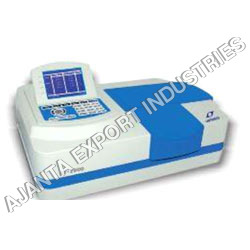
With the help of our expert workforce, we are designing and developing a sustainable range of UV-Vis Spectrophotometer. These devices are fabricated under proper supervision of deft team of professionals. Furthermore, our respected clients can avail these quality-approved products at market-leading conveniently.
Features:
Specifications:| Wave Length Range | 190 to 1100 nm |
| Spectral Bandwidth | 1 nm |
| Working Mode | T.A.C.E |
| Optical System | Double beam |
| Scanning Speed | Fast/medium/slow |
| Photometric Range | 0.3 to 3.5A, 0 to 220% T |
| wave Length Accuracy | 0.3 nm |
| Wave Length |
|
| Reproducibility | <0.10nm |
| Photometric Accuracy | 0.3% T(0-100% T)
0.002A(0-0.1A) |
| Photometric |
|
| Reproducibility | <0.15% T |
| Stray Light | <0.1% T(Nal.220nm NanO 340nm) |
| Baseline Flatness | 0.002 A |
| Stability | <0.001A/h(at 500nm, after warning up) |
| Cell Container | Autometic 8 Cell Changer |
| Noise | 0.001A (at 500 nm, after warning up) |
| Detector | Dual Silicon |
| Display | 6 inches high light blue LCD |
| Power | 230 10?, 50 Hz |
| Dimensions | 630x470x210 mm |
| Weight | 26 kg (approx) |
Equipped with dual beam optics, this UV-Vis Spectrophotometer enables simultaneous reference and sample analysis, ensuring high accuracy and stability. This technology minimizes baseline drift and enhances reliability for both quantitative and qualitative assays, making it suitable for research and industrial laboratories.
Comprehensive Wavelength ScanningWith a wavelength range of 190-1100 nm, this instrument caters to diverse analytical needs. Automatic wavelength setting and scanning empower quick, precise detection of different compounds. The standard 10 mm quartz cuvette allows compatibility with a wide range of samples for versatile applications.
Intuitive Digital Operation and ConnectivityThe spectrophotometer features LCD digital display and software-based control, providing seamless operation and easy data management. Built-in USB and RS232 ports allow hassle-free data export and integration with analysis software, facilitating efficient workflow in modern laboratories.
FAQ's of UV Vis Spectrophotometer:
Q: How does the automatic wavelength setting benefit laboratory procedures?
A: The automatic wavelength setting streamlines measurements by precisely selecting the required wavelength for analysis, reducing manual intervention and minimizing human error. This enhances consistency and efficiency in laboratory workflows, especially during routine or high-throughput analyses.
Q: What types of samples can be analyzed using the standard quartz cuvette?
A: The 10 mm standard quartz cuvette is compatible with a wide variety of transparent liquid samples, including organic and inorganic solutions. Its high UV transparency allows accurate measurements across the full wavelength range, making it suitable for diverse applications in research, pharmaceutical, and educational labs.
Q: When is it necessary to calibrate the spectrophotometer, and what is the process?
A: Calibration should be carried out routinely as recommended in the user manual, or whenever accuracy needs to be verified. The process involves using reference standards to check wavelength accuracy and photometric linearity, and the built-in software guides users through step-by-step calibration procedures.
Q: Where can this UV-Vis Spectrophotometer be effectively used?
A: This instrument is designed for use in laboratory environments, including academic, industrial, pharmaceutical, and research laboratories. Its robust design and precise measurement capabilities make it suitable for routine analysis, method development, and quality control testing.
Q: How does the stability specification enhance analytical results?
A: With a stability of 0.002 A/h at 500 nm, the spectrophotometer maintains consistent absorbance readings over extended periods. This minimizes drift and ensures reliable, reproducible results, which is especially critical for sensitive assays and long-duration experiments.
Q: What advantages does the USB and RS232 data output provide?
A: USB and RS232 data ports enable rapid data transfer to computers or external devices, facilitating easy analysis, storage, and reporting. This connectivity supports efficient data management and integration with lab information systems, enhancing productivity.







 English
 Spanish
 French
 German
 Italian
 Chinese (Simplified)
 Japanese
 Korean
 Arabic
 Portuguese


 Send Inquiry

