Product Description
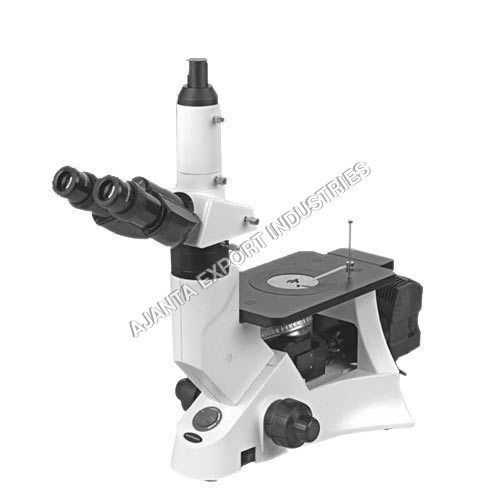
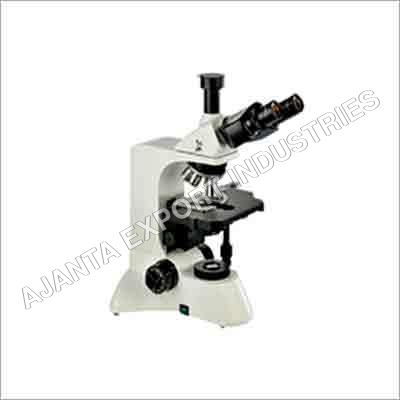
Inverted Metallurgical Microscopes
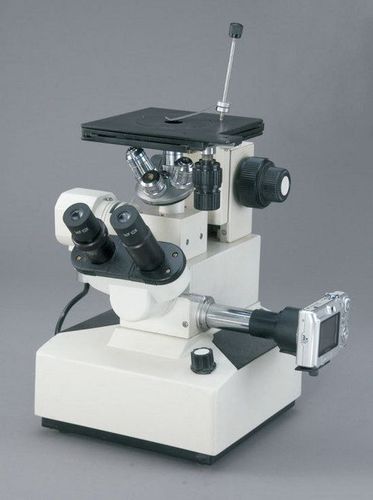
We are engaged in offering our clients a wide range of NIM-100 Inverted Metallurgical Microscopes. Stable stand structure and advance stage design, make these NIM-100 Inverted Metallurgical Microscopes highly efficient. Sturdily constructed these Microscopes are made as per international industry standards and are very easy to operate and maintain. These NIM-100 Inverted Metallurgical Microscopes are extensively used for the metallurgical examination of alloys and metals.
Specification :
| Viewing head | Trinocular head inclined at 30o,interpupillary48-75mm |
| Eyepiece | High-point ,extra wide field eyepiece EW10/20 |
| Nose piece | Quintuple nose piece |
| Objective | Plan achromatic objective 4102040 |
| Focusing | Coaxial coarse and fine adjustment vertical objective movement coarse stroke 37.7mm per rotation fine stroke 0.2mm per rotation |
| Kohler illumination | Halogen lamp 6V30W |
| Filter | Blue yellow green and ground glass |
| Polarization attachment | |
| Photo attachment | Photo attachment |
| Video adapter | Video adapter with C mount |
| Stage | Plain stage 160250mm mm |
| Attachable mechanical stagey coaxial control
moving range 12078mm |
| Auxiliary stage 70180mm |
Advanced Optical SystemEquipped with infinity-corrected optics, plan achromatic objectives, and anti-fungal widefield eyepieces, this microscope ensures astonishing image clarity and color fidelity. The trinocular, 360 rotatable head supports camera attachment for high-resolution documentation and analysis.
Precision and FlexibilityThe robust X-Y mechanical stage with vernier scale enables meticulous positioning of heavy or irregular samples, while the coaxial coarse and fine focus system provides precise control for high-magnification work. Adjustable illumination and tension adjustment ensure the instrument adapts easily to various applications.
Optimized for Metallography and ResearchWith its inverted construction and long working distance objectives, the microscope facilitates detailed examination of metallographic specimens without cutting or damaging them. This makes it invaluable for quality control, material research, and industrial laboratories.
FAQ's of Inverted Metallurgical Microscopes :
Q: How does the inverted design benefit metallurgical sample observation?
A: The inverted construction allows users to place samples directly on the stage and observe their surfaces from below, eliminating the need for sectioning or destructive preparation. This is especially advantageous for large, mounted, or polished specimens common in metallography and material science.
Q: What types of analyses and applications is this microscope ideal for?
A: This microscope is particularly suited for metallography, material science, quality control, and industrial laboratory research. It excels at examining metals, alloys, coatings, and other solid materials where surface features must be studied without altering the sample.
Q: What is the process for capturing images and video with this microscope?
A: The trinocular head supports the mounting of optional digital cameras, which connect via USB or DVD interface. Users can capture still images in formats like JPG, PNG, BMP and record video up to 1080p Full HD, with resolutions dependent on the camera used (up to 12MP possible).
Q: What are the stages of focusing and how precise is adjustment?
A: Focusing uses a coaxial coarse and fine system. The coarse focus enables 30mm of vertical travel, suitable for broad movements, while the fine focus offers 0.002mm precision, ideal for high-resolution work and precise surface analysis.
Q: Where can these inverted metallurgical microscopes be used?
A: Their design makes them ideal for use in research laboratories, metallurgical quality control, educational institutions, and industrial material testing environments. The anti-vibration frame and robust build support reliable use in challenging settings.
Q: What are the main benefits of using an infinity-corrected optical system?
A: Infinity-corrected optics provide superior image clarity, minimize optical aberrations, and allow for flexible modification (such as camera attachments or filters) without compromising image quality or focus.
Q: How are samples positioned and observed on this microscope?
A: Samples are placed on a spacious rectangular mechanical stage (210x140mm) and positioned using X-Y mechanical movement with a vernier scale. Observation is conducted from below via the inverted objective, providing unobstructed imaging of the specimen's surface.







 English
 Spanish
 French
 German
 Italian
 Chinese (Simplified)
 Japanese
 Korean
 Arabic
 Portuguese


 Send Inquiry

