Product Description
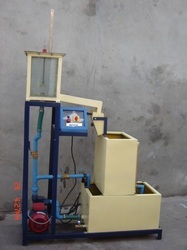
The setup is designed to study the forced developed by a jet of water on different surfaces and to compare it with momentum theory.
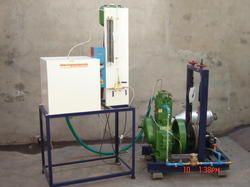
Set up consists of visible test enclosure, supply tank, measuring tank and pump for closed loop water circulation. The visible test section housed one nozzle fitted in vertical upward direction to target the jet of water opposite an interchangeable test surface (either flat plate or a hemispherical cup) which in term is connected to a spring loaded stem. The lift of stem and weight added to the pan on other side gives the calculation of corresponding force.
The flow rate of water is measured using measuring tank and stop watch provided
Experiments
- To study the force developed by impact of jet on different surfaces
Utilities Required
- Electric supply 0.5 kW, 220V AC, Single Phase
- Water supply Tap water connection BSP Distilled water @ 60 liters (optional)
- Floor Area with Drain facility
Experience Reliable Fluid Mechanics DemonstrationsDesigned with laboratory precision, the apparatus allows students and researchers to observe the direct interaction between water jets and various vane configurations. The use of stainless steel ensures longevity, even under continuous experimental conditions. Its broad temperature and voltage compatibility make it versatile for different global standards.
Built to Meet Rigorous Educational DemandsThis apparatus serves as an essential teaching tool for understanding fundamental concepts in hydraulic engineering. It is manufactured with strict quality standards by reputed Indian suppliers and is widely used in colleges, universities, and engineering labs across the country.
FAQ's of Impact of Jet On Vanes Apparatus:
Q: How does the Impact of Jet on Vanes Apparatus function in a laboratory setting?
A: The apparatus demonstrates the effect of a water jet striking different vanes, allowing users to measure and analyze the resulting impact force. It is typically used to explore fundamental hydraulic principles in controlled laboratory environments.
Q: What materials are used in constructing the apparatus, and what advantages do they provide?
A: The primary construction material is stainless steel, which offers excellent corrosion resistance, durability, and ensures the apparatus can withstand frequent use and exposure to water.
Q: When should this apparatus be used during fluid mechanics studies?
A: It is most effectively utilized during practical sessions related to fluid jets, momentum analysis, and fluid-structure interaction topics in laboratory courses, demonstrations, or research projects.
Q: Where is the Impact of Jet on Vanes Apparatus commonly supplied and used?
A: This apparatus is manufactured, supplied, and exported by Indian distributors, and it is commonly found in educational laboratories, engineering institutes, and research facilities throughout India and internationally.
Q: What process does the apparatus help to demonstrate?
A: It visually and quantitatively demonstrates the transfer of momentum from a jet of water to vanes of varying shape and orientation, providing insight into fluid impact dynamics and energy transfer.
Q: How is the apparatus beneficial for laboratory usage?
A: By facilitating repeatable and accurate hydraulic experiments, this apparatus enhances practical understanding, aids in validating theoretical calculations, and supports hands-on learning for students and researchers alike.







 English
 Spanish
 French
 German
 Italian
 Chinese (Simplified)
 Japanese
 Korean
 Arabic
 Portuguese


 Send Inquiry

