Product Description
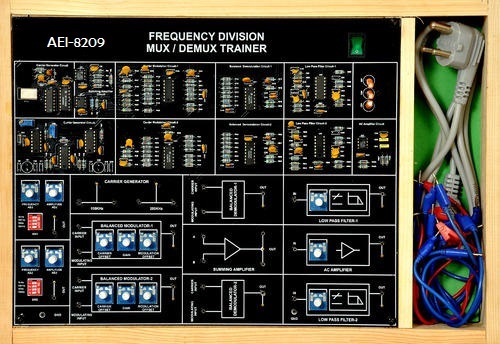
Frequency Division Multiplexer/Demultiplexer Trainer Salicon AEI-8209 demonstrates FDM technique. It basically fulfills the need for communication of two different inputs through a single channel by Frequency Division Multiplexing method.AEI-8209 has the provision for onboard modulating signal For reducing the complexity same carriers are used for demodulation also.In actual FDM communication method carrier is obtained through the modulated output only. But the basic concept remains the same. DSB-SC modulation technique is used for modulation and demodulation.
Features:
- A self contained Trainer
- Functional blocks indicated on board mimic
- Input-output and Test Points provided onboard
- Built in DC Power Supply
- Fully documented student work book & operating manual
- Two variable modulating (sinusoidal) input channels with provision of voice inputs
- Two Carrier Generators
- Two DSBSC modulators for frequency band translation of two test signals
- One adder/transmission amplifier
- Two Demodulators
- Two low pass filters for smooth output
- 2 Sets of audio O/P amplifier
- Compact size
- 2 Year Warranty
Specifications:
- Modulating Input Frequency : Sine wave 200 Hz - 10 KHz(variable)
- Audio Input Amplifier : Gain of 100 (approx.)
- Modulator / Demodulator : DSBSC Modulator/Demodulator
- Low Pass Filters : Second Order Butterworth filters with a cut off frequency of 10 KHz
- Audio Output Amplifier : Output Amplifier with a gain of 20
- Interconnections : :2 mm Banana Sockets
- Test points : 30 nos
- Power Supply : 230 V ±10 %, 50/60 Hz
- Power Consumption : 3 VA approximately
Hands-on Learning with Real-time ObservationThis trainer board is equipped with multiple test points and LED indicators, allowing students to monitor signal multiplexing and demultiplexing in real time. The built-in audio output and onboard function generators make it easy for users to see and hear the effects of frequency division, supporting effective learning and retention of key concepts.
Versatile Signal Handling for Comprehensive DemonstrationCapable of handling sine, square, and audio signals, the AEI-8209 trainer demonstrates the core principles of multiplexing in communication systems. With 3 or 4 selectable channels and easy signal selection using manual switches, users can experiment with different combinations to observe channel separation and the role of FDM in data transmission.
Robust Design and Complete AccessoriesFeaturing a sturdy ABS case with a powder-coated metal front panel and high-quality PCB, the trainer stands up to regular laboratory use. It comes with a complete set of connection leads, power cord, and experiment manual for immediate setup and a smooth hands-on experience for students.
FAQ's of Frequency Division Multiplexer/Demultiplexer Trainer-AEI-8209:
Q: How does the Frequency Division Multiplexer/Demultiplexer Trainer AEI-8209 work?
A: The trainer transmits multiple signals (sine, square, or audio) over separate frequency channels simultaneously. Students can observe signal combination and separation using provided test points and speakers, illustrating practical FDM concepts.
Q: What types of signals can be multiplexed and demultiplexed with this trainer?
A: The AEI-8209 can handle sine, square, and audio signals, making it suitable for a range of experiments involving different waveform types.
Q: When is this equipment typically used in a laboratory setting?
A: It is primarily employed during communications engineering courses or electronics labs to demonstrate frequency division multiplexing/demultiplexing principles, helping students visualize multiplexing, analyze waveforms, and understand channel separation.
Q: Where can I observe signal outputs and perform measurements on the trainer?
A: Test points are provided on the board for direct waveform observation with an oscilloscope or multimeter. Audio outputs through onboard speakers further allow practical monitoring of demultiplexed audio signals.
Q: What is the process for setting up and using the trainer for experiments?
A: Connect the trainer to a 220V AC mains supply, select the desired signal channels via manual switches, use the banana sockets for external connections, and refer to the included manual for step-by-step experimental procedures and configurations.
Q: How does this trainer benefit students and educators?
A: It provides hands-on, interactive learning on FDM principles, enabling students to gain practical insights, visualize multiplexed signals, and evaluate real-world applications of communication technologies.







 English
 Spanish
 French
 German
 Italian
 Chinese (Simplified)
 Japanese
 Korean
 Arabic
 Portuguese


 Send Inquiry

