Product Description
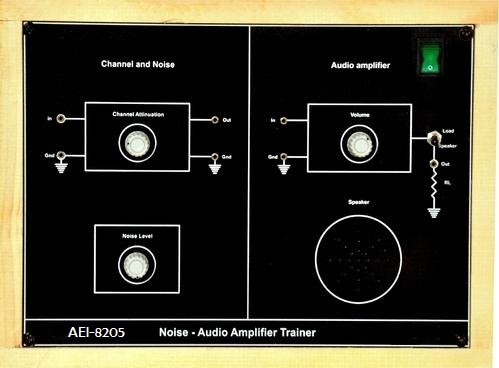
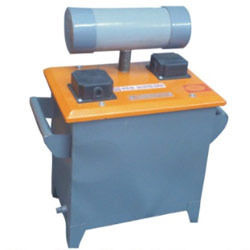
AJANTA AEI-8205 Noise & audio amplifier is a communication system which specifies basic concepts of noise generation & its amplification. Noise & signal adder where noise is added to signal and its amplitude is adjusted from 0 to max of I/P value. It consists of an audio amplifier section in which signal +noise can be amplified and its effects can be examined on loud speaker.
Features:
- A self contained Trainer
- Functional blocks indicated on board mimic Input-output and Test Points provided onboard Built in DC Power Supply
- Fully documented student work book & operating manual
- Attractive Wooden enclosures of Light weight
- Australian Pine Wood.
- Compact size
- 2 Year Warranty
Specifications:
- Audio Amplifier with Loud speaker : 8W, 0.25 W
- Interconnections : 2 mm Banana Sockets
- Power Supply : 230 V 10 %, 50/60 Hz
- Power Consumption : 3 VA approximately
- Operating Conditions : 0-40oC, 80% RH
- Dimensions (mm): W 190 x D 279 x H 95
- Weight: 2.5 Kg approximately
For more details, click on the attached PDF.
Comprehensive Hands-On Audio TrainingThe AEI-8205 trainer provides an interactive platform for students to explore and experiment with noise generation, audio signal amplification, and measurement techniques. Its modular design and interconnected block diagram make it ideal for understanding theory and practice in audio electronics.
Safe and Durable ConstructionDesigned with laboratory use in mind, the AEI-8205 boasts a shock-proof, metal housing and premium components for sustained durability. Integrated protective features guard against overload and short circuit scenarios, ensuring student safety and equipment longevity during use.
Versatile Experimentation and Easy OperationSupporting sine, square, and noise waveforms as input, this trainer enables a wide array of experiments. Clearly labeled test points and manual controls, along with supplied patch cords and instruction manual, make setup straightforward and learning seamless for both students and educators.
FAQ's of Noise & Audio Amplifier Trainer- AEI-8205:
Q: How can students use the AEI-8205 Noise & Audio Amplifier Trainer in laboratory sessions?
A: Students can utilize the AEI-8205 to perform practical experiments in noise generation, signal tracing, audio amplification, and measurement. By connecting the supplied patch cords and following the instruction manual, they can observe how different input signals (sine, square, and noise waveforms) pass through various modules, such as the noise generator, pre-amplifier, and audio amplifier.
Q: What are the main benefits of using this trainer for educational purposes?
A: The AEI-8205 offers hands-on experience with real audio signaling and amplification processes, fostering a deeper conceptual understanding for learners. Its user-friendly design, clearly labeled modules, and onboard speaker facilitate easy learning. The built-in protection features ensure safe usage, making it suitable for frequent use in academic environments.
Q: When is it appropriate to use each experimental module on the AEI-8205?
A: Each module serves a specific learning objective: the noise generator is used for studying different forms of noise and their properties; the pre-amplifier module is ideal for initial signal boosting; the audio amplifier module demonstrates how signals are further enhanced for output; and the speaker out allows students to audibly perceive the amplified signals. These modules can be used sequentially or separately depending on the lesson focus.
Q: Where can the AEI-8205 be most effectively utilized?
A: This trainer is most effective in school, college, and technical institute laboratories. Its durable design and comprehensive features make it an excellent choice for structured classroom demonstrations, guided student experiments, and technical skill development in electronics and communications courses.
Q: What process should be followed to measure signal characteristics using the trainer?
A: To measure signal characteristics, students should connect the input to the desired waveform (sine, square, or noise), trace the signal via the clearly marked test points throughout each module, and use external meters or oscilloscopes where needed. The instruction manual provides step-by-step guidelines for accurate measurement and analysis.
Q: How does the onboard speaker contribute to the learning process?
A: The onboard speaker allows students to directly hear the results of their signal amplification experiments. This immediate audio feedback makes the impact of adjustments and module changes more tangible, reinforcing theoretical principles through practical application.







 English
 Spanish
 French
 German
 Italian
 Chinese (Simplified)
 Japanese
 Korean
 Arabic
 Portuguese


 Send Inquiry

