Product Description
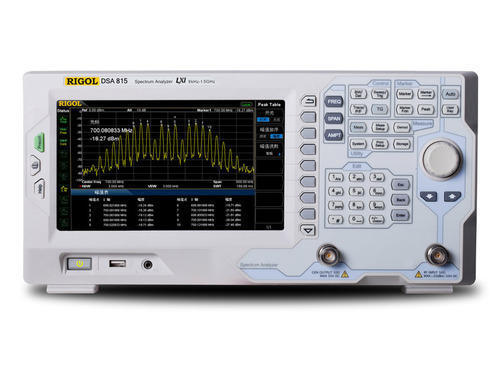
The Rigol DSA875 is a compact and light weight Spectrum Analyzer with premium performance for portable applications. The use of digital IF (intermediate frequency) technology guarantees reliability and performance to meet the most demanding RF applications.
The very large display (20.3 cm / 8") of the Rigol DSA875 Spectrum Analyzer provides a resolution of 800x480 pixels allowing a very good overview of all its comfortable functions like Auto Tune, Auto Range, Auto Scale and Auto Couple. These functions enable the analyzer to acquire signals and match parameters automatically, compared to the manual process necessary with a traditional analyzer.
The Rigol Spectrum Analyzers have a sophisticated and easy to use user interface offering multiple functions for all tasks. The menu navigation is very intuitive and all functions and parameters are easy to locate thanks to the graphical interface.
Wide Frequency and High SensitivitySpanning frequencies from 9 kHz to 7.5 GHz and offering a displayed average noise level as low as -161 dBm (with preamp), the DSA875 is well-suited for analyzing both weak and strong signals. Its finely adjustable resolution bandwidth (from 10 Hz to 1 MHz in steps) ensures precise spectrum measurements for demanding applications.
User-Centric Design and Advanced DisplayEquipped with a 10.1-inch TFT-LCD and intuitive controls-both touch and push button-the DSA875 delivers a clear, efficient user experience. High-resolution display and user-friendly interface contribute to accessible and accurate measurement readings, streamlining laboratory workflows.
Versatile Connectivity and Robust BuildThe spectrum analyzer features USB Host/Device, LAN, and HDMI ports, facilitating easy integration with computers, networks, and display systems. Housed in a durable, industrial-grade body with a metal chassis, it withstands rigorous laboratory and industrial environments.
FAQ's of 7.5Ghz Spectrum Analyzer-DSA875:
Q: How can I set the resolution bandwidth on the DSA875 spectrum analyzer?
A: You can adjust the resolution bandwidth on the DSA875 step-by-step from 10 Hz up to 1 MHz, allowing you to fine-tune signal analysis based on your measurement needs. This is done through the user interface, either by touch or push button control.
Q: What is the main benefit of using the built-in preamplifier on this analyzer?
A: The built-in preamplifier significantly improves sensitivity, enabling the detection and measurement of very weak signals. With preamp enabled, the displayed average noise level achieves -161 dBm, making low-level signal analysis highly accurate.
Q: When is the tracking generator needed, and is it included?
A: The tracking generator, offered as an optional accessory, is especially useful for network analysis and measuring filter or cable response. It is not standard, so if your applications require stimulus-response testing, consider adding it to your configuration.
Q: Where can the DSA875 spectrum analyzer be used effectively?
A: This analyzer is ideal for laboratory research, RF component testing, manufacturing, education, and industrial applications. Its robust design and comprehensive connectivity make it suitable for diverse technical environments.
Q: What process should I follow to connect the DSA875 to a computer or external display?
A: To connect the analyzer, use the provided USB, LAN, or HDMI ports. This enables remote control, data transfer, and external video display. Ensure compatible cables are used and configure network or device settings according to your laboratory's requirements.
Q: How does the temperature resistance of the DSA875 enhance its usage?
A: Engineered to operate reliably between 0C and 40C, the analyzer ensures consistent performance in a wide range of laboratory and industrial settings, supporting continuous operation even in variable climates.
Q: What are the key advantages of the DSA875's user interface and display?
A: The 10.1-inch TFT-LCD display provides clear signal visualization, while the combination of touch and push button control offers flexibility and speed. This enhances user productivity, streamlines measurements, and accommodates varied operator preferences.







 English
 Spanish
 French
 German
 Italian
 Chinese (Simplified)
 Japanese
 Korean
 Arabic
 Portuguese


 Send Inquiry

