Product Description
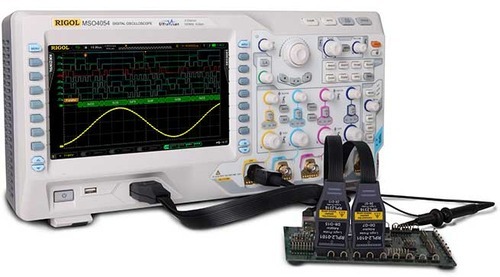
The Rigol MSO4054 is a very high quality four channel digital storage oscilloscope with build in logic analyser. It offers up to 4 GSa/s real-time sample rate, up to 500 MHz analogue bandwidth and 28 Mpts memory per digital channel at up to 1 GSa/s sample rate.
These high performances ensure not only to capture real-time instantaneous signal, but also to observe details of repeated signal. MSO4054 have up to 110.000 wfms/s refresh rate, which enable users to capture instantaneous signal and abnormal signal more quickly, to enhance waveform capturing ability, and to expedite circuit debug course. The quality of the Rigol Oscilloscopes is comparable to Agilent and Tektronix oscilloscopes.
Other advantages: 9" color LCD, bright and vivid waveform display; versatile trigger modes: i.e. slope, alternative, rise&fall edge, enable users to stabilize signal more easily. In economical oscilloscope field, MSO4054 have no doubt the highest performances, the most functions thus should be engineers best choice.
Comprehensive Testing with Analog and Digital ChannelsThis oscilloscope provides 4 high-bandwidth analog channels and 16 digital logic analyzer inputs, enabling simultaneous measurement and analysis of both analog and digital signals. Engineers can debug mixed-signal circuits efficiently, making it highly suitable for complex electronic system development and troubleshooting.
Advanced Trigger and Measurement FunctionsEquipped with versatile trigger modes-including edge, pulse width, logic, video, and slope-the device ensures precise event capture. The oscilloscope supports auto and manual cursor measurement, as well as advanced math functions like addition, subtraction, multiplication, and FFT, offering in-depth waveform analysis.
Superior Connectivity and Data ManagementFeaturing both front-panel USB Host and rear USB Device ports, along with LAN interface (10/100Mbps), data transfer and remote operation are seamless. The large internal memory and USB flash storage support long-duration waveform recording, essential for capturing rare or complex signal anomalies.
FAQ's of 4ch. DSO with 500MHz,4GSa/s with 16ch Logic Analyzer:
Q: How does the integrated logic analyzer enhance the digital signal analysis capabilities of this oscilloscope?
A: The built-in 16-channel logic analyzer allows for real-time monitoring of multiple digital signals alongside analog channels. This mixed-signal capability streamlines the debugging process for embedded systems and complex circuits that require correlation between analog and digital events.
Q: What types of applications are best suited for using this 4-channel DSO with logic analyzer?
A: This oscilloscope is ideal for laboratory research, electronics development, system debugging, and educational purposes. Applications range from testing communication interfaces to analyzing timing and logic states in embedded designs, providing versatility for engineers and educators alike.
Q: When should you use the advanced trigger modes available on this model?
A: Advanced trigger modes, such as pulse width, logic, and video triggers, should be used when specific signal events need to be isolated or captured. These modes enable precise synchronization to complex waveforms, helping users pinpoint rare faults or protocol errors.
Q: Where can data recorded on the oscilloscope be stored or exported?
A: Data can be saved internally or exported directly to a USB flash drive via the front-panel USB Host. For remote data transfer or control, the LAN interface provides connectivity to Windows or Linux computers using remote PC software, simplifying data management and reporting workflows.
Q: What is the process for connecting external devices to this oscilloscope for signal acquisition or data transfer?
A: External devices can be connected through the various probe inputs for analog and digital channels. For data transfer, use the front USB port for quick access with a flash drive, the rear USB for device connections, or the LAN port for network-based communication and remote operations.
Q: How does the high waveform update rate benefit waveform analysis?
A: A waveform update rate of up to 50,000 wfms/s allows the oscilloscope to quickly refresh signal displays, making it easier to visualize rapidly changing waveforms or capture intermittent glitches. This enhances the detection and diagnosis of rare or fleeting signal events.







 English
 Spanish
 French
 German
 Italian
 Chinese (Simplified)
 Japanese
 Korean
 Arabic
 Portuguese


 Send Inquiry

