Product Description
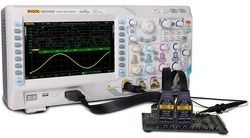
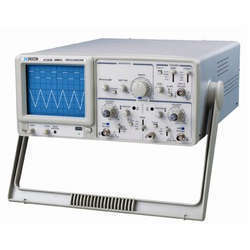
The Rigol MSO4024 is a very high quality four channel digital storage oscilloscope with build in logic analyser. It offers up to 4 GSa/s real-time sample rate, up to 200 MHz analogue bandwidth and 28 Mpts memory per digital channel at up to 1 GSa/s sample rate.
These high performances ensure not only to capture real-time instantaneous signal, but also to observe details of repeated signal. MSO4024 have up to 110.000 wfms/s refresh rate, which enable users to capture instantaneous signal and abnormal signal more quickly, to enhance waveform capturing ability, and to expedite circuit debug course. The quality of the Rigol Oscilloscopes is comparable to Agilent and Tektronix oscilloscopes.
Other advantages: 9" color LCD, bright and vivid waveform display; versatile trigger modes: i.e. slope, alternative, rise&fall edge, enable users to stabilize signal more easily. In economical oscilloscope field, MSO4024 have no doubt the highest performances, the most functions thus should be engineers best choice.
Comprehensive Signal AnalysisEquipped with both analog and digital measurement capabilities, this device enables full-spectrum analysis for electronic engineers and technicians. Whether measuring analog waveforms at 200 MHz bandwidth or decoding digital signals from embedded systems, the DSO facilitates accurate and efficient troubleshooting.
Advanced Features and Deep MemoryBenefit from a high waveform update rate (up to 120,000 wfms/s) and a memory depth of up to 28 Mpts per channel. These features allow for capturing long signal sequences and rare events with exceptional clarity. Multiple trigger types and math functions further expand analysis possibilities.
User-Friendly and Durable DesignThe color LCD displays data clearly, while knob and push button controls provide intuitive operation. Multi-language support and easy firmware upgrades ensure adaptability. Built with ABS and aluminum, the unit withstands rigorous lab environments, and its compact design suits various workspaces.
FAQ's of 4ch. DSO with 200MHz,4GSa/s with 16ch. Logic Analyzer:
Q: How do I connect and operate the 4-channel DSO for electronic signal measurements?
A: Simply plug in the oscilloscope to an AC mains supply (100-240V, 50/60 Hz), connect your probes (compatible with 1X, 10X, 100X, and 1000X attenuation), and select the desired channels using the front panel controls. Use the 7-inch color LCD and intuitive knobs or push buttons to navigate menus, set triggers, and view waveforms.
Q: What advantages does the integrated 16-channel logic analyzer offer?
A: The built-in logic analyzer provides simultaneous digital signal analysis with up to 16 channels, making it ideal for embedded system debugging. It supports a digital sampling rate up to 1 GSa/s, allowing users to monitor and decode complex digital buses alongside analog signals, thus streamlining mixed-signal verification.
Q: When should I use the mathematical and measurement functions such as FFT on this oscilloscope?
A: Mathematical functions like FFT (Fast Fourier Transform), addition, subtraction, and multiplication are ideal for advanced signal analysis. For example, use FFT to examine frequency components of a waveform or employ math operations to compare signals across channels during troubleshooting and design validation.
Q: Where can I store captured data and waveforms from this DSO?
A: You can save waveform data and measurement results either to a USB flash drive using the USB Host port or to the unit's built-in memory. This flexibility enables easy data transfer for reporting, sharing, and post-analysis on a PC.
Q: What are the main safety and compatibility features of this device?
A: The oscilloscope supports CAT II 300V ratings, an input impedance of 1 M 2%, and maximum input voltage up to 400V (DC+AC peak), ensuring safe operation in laboratory environments. It accommodates a variety of probes and operates reliably within temperatures up to 50C.
Q: How does the oscilloscope facilitate firmware updates and multi-language support?
A: Firmware upgrades are supported via USB, allowing you to update the device seamlessly for enhanced features or performance. The user interface supports multiple languages, making it accessible and user-friendly for technicians and engineers globally.






 English
 Spanish
 French
 German
 Italian
 Chinese (Simplified)
 Japanese
 Korean
 Arabic
 Portuguese


 Send Inquiry

