Product Description
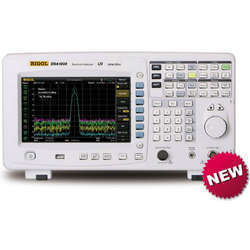
The Rigol DSA1020 is a compact and light Spectrum Analyzer with premium performance for portable applications. The use of digital IF (intermediate frequency) technology guarantees reliability and performance to meet the most demanding RF applications.
The very large display (21.6cm / 8.5") of the Rigol DSA1020 Spectrum Analyzer with a resolution of 800x480pixels provides a very good overview over all its comfortable functions like Auto Tune, Auto Range, Auto Scale and Auto Couple. These functions enable the analyzer to acquire signals and match parameters automatically, instead of the manual process necessary with a traditional analyzer. The Rigol Spectrum Analyzers have a sophisticated and easy to use user interface and offers multiple functions for all tasks. The menu navigation is very institutional in use and all functions and parameters are easy to reach because of the graphical interface.
Advanced Spectrum Analysis for ProfessionalsTailored for laboratories and technical environments, this spectrum analyzer delivers a wide frequency range with high accuracy and dynamic range. Its robust interfaces and intuitive controls allow seamless integration into various testing setups, making it a reliable companion for radio frequency analysis and troubleshooting.
Designed with Portability and Versatility in MindThe compact, lightweight build of this analyzer makes transportation and setup effortless. Coupled with its high sensitivity and multiple interface support (USB, LAN, GPIB), it caters to diverse testing applications, whether you're engaged in research, manufacturing, or field testing.
FAQ's of 2GHZ Spectrum Analyzer:
Q: How do I operate the 2GHz Spectrum Analyzer for frequency measurements?
A: Operating the analyzer is straightforward-connect your device under test to the N-type (female) input, power the unit via AC mains, and use the panel buttons and rotary knob to configure sweep time, resolution bandwidth, and other settings. All results are displayed on the clear LCD display for easy observation.
Q: What kind of environments is this spectrum analyzer suitable for?
A: This analyzer is designed for laboratory environments but thanks to its portability and robust construction, it can also be used for field testing in a variety of professional settings where radio frequency analysis is essential.
Q: When should I select different resolution bandwidths on this analyzer?
A: You should adjust the resolution bandwidth between 10 Hz and 1 MHz based on your measurement needs-use narrower bandwidths for detailed signal analysis and wider bandwidths for faster sweeps across broader frequencies.
Q: Where can I connect the spectrum analyzer to external devices?
A: You can connect external devices using its USB, LAN, and GPIB interfaces, allowing efficient data transfer, remote control, and integration with various laboratory equipment and networks.
Q: What benefits does the high dynamic range and low spurious response offer?
A: A dynamic range greater than 80 dB and spurious response lower than -90 dBc help ensure highly accurate measurements. These features minimize signal distortion and interference, essential for reliable signal identification and analysis.
Q: How does the LCD display enhance the user experience?
A: The LCD display provides sharp, real-time visualization of signal spectra and settings, making it easy to interpret results, navigate options, and monitor testing processes even in brightly lit laboratory environments.







 English
 Spanish
 French
 German
 Italian
 Chinese (Simplified)
 Japanese
 Korean
 Arabic
 Portuguese


 Send Inquiry

