Product Description
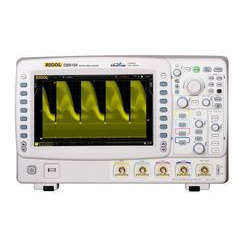
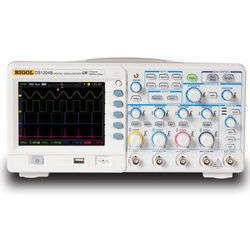
1GHZ with 4Channel Digital Storage Oscilloscope is a very high quality four channel digital storage oscilloscope. It offers up to 5 GSa/s real-time sample rate and up to 1 GHz bandwidth.
These high performances ensure not only to capture real-time instantaneous signal, but also to observe details of repeated signal. DS6104 have up to 180.000 WFMS/s refresh rate, which enable users to capture instantaneous signal and abnormal signal more quickly, to enhance waveform capturing ability, and to expedite circuit debug course. The quality of the Rigol Oscilloscopes is comparable to Agilent and Tektronix oscilloscopes.
Other advantages: 10.1" color LCD, bright and vivid waveform display; versatile trigger modes: i.e. slope, alternative, rise&fall edge, enable users to stabilize signal more easily. In economical oscilloscope field,
Exceptional Performance for High-Frequency SignalsEquipped with a 1 GHz bandwidth and up to 5 GS/s sampling rate on each channel, this oscilloscope captures even the fastest transient signals with high fidelity. Its 40 Mpts memory depth per channel ensures smooth, detailed waveform acquisition, crucial for advanced diagnostics in research and laboratory settings.
Intuitive User Interface and Enhanced ConnectivityThe device features a 10.1-inch color TFT LCD with easy-to-use rotary knobs, push-buttons, and a digital interface. Multi-language support and simple save/print functions streamline operation, while robust connectivity options-including USB, LAN, and VGA-facilitate versatile data transfer and remote monitoring.
Reliable and Compliant Laboratory SolutionCertified by CE, RoHS, and ISO 9001 standards, this digital storage oscilloscope is engineered with a durable industrial-grade plastic and aluminum casing. Designed for laboratory environments, it operates reliably between 0C and 50C, ensuring accurate, repeatable results for a variety of measurement tasks.
FAQ's of 1GHZ with 4Channel Digital Storage Oscilloscope:
Q: How do I set up and use the 1 GHz 4-Channel Digital Storage Oscilloscope in a laboratory environment?
A: Setting up the oscilloscope involves connecting the unit to the power supply (100-240V AC), attaching the probes to the desired input channels, and powering on the device. Use the rotary knobs, push-buttons, and intuitive digital interface to adjust vertical sensitivity, time base, and trigger settings for your test signals. With easy navigation and multi-language support, the oscilloscope is suitable for a range of laboratory research applications.
Q: What types of measurements can this oscilloscope perform, and what is its accuracy?
A: This oscilloscope supports multiple trigger modes (Edge, Pulse, Video, Slope, Alternate, Pattern) and advanced math functions such as addition, subtraction, multiplication, and FFT for waveform analysis. Its vertical accuracy is 3%, and timebase accuracy is 25 ppm, making it precise for both qualitative and quantitative signal investigations.
Q: When should I use the various probe attenuation settings?
A: Probe attenuation (1x, 10x, 100x, 1000x) should be selected based on the signal amplitude and required measurement range. Use higher attenuation for measuring larger signals to prevent oscilloscope overloading, and lower settings for small signal details. The oscilloscope automatically compensates for different probe factors, ensuring consistent results.
Q: Where can I save and export waveform data captured by this oscilloscope?
A: Waveform data can be easily saved via USB storage, transferred over LAN, or exported directly using the built-in USB host/device and VGA output for reports and documentation. This functionality supports seamless data sharing and backup, essential for collaborative research or record-keeping.
Q: What benefits does this oscilloscope offer for research and advanced diagnostics?
A: With its high sample rate, deep memory, multiple trigger types, and comprehensive math functions, researchers can accurately capture, analyze, and interpret fast and complex electrical signals. The flexible connectivity and compliance with industry standards further ensure convenience, safety, and reliability in demanding laboratory settings.
Q: How does the oscilloscope maintain performance under different temperature conditions?
A: The instrument is designed for operation in temperatures from 0C to 50C and storage from -20C to 70C. Its robust build with industrial-grade materials ensures stable performance and durability, even in varied laboratory environments.







 English
 Spanish
 French
 German
 Italian
 Chinese (Simplified)
 Japanese
 Korean
 Arabic
 Portuguese


 Send Inquiry

