Product Description
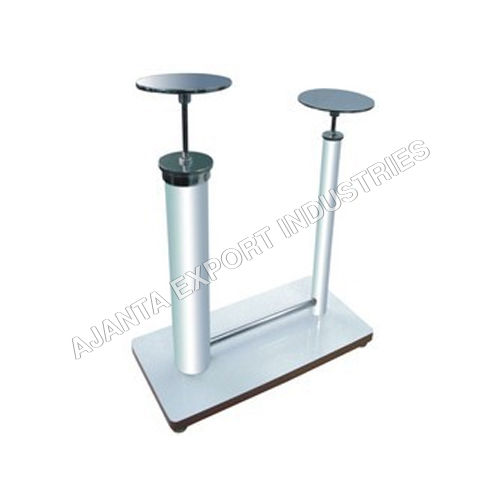
Demonstrates the phenomenon of transmissibility of fluid pressure. For the same force exerted, pressure is inversely proportional to the surface area. The apparatus comprises of the plated brass cylindrical tubes of different diameters, each fitted with piston and connected to each other through a brass tube at their bottom. Pistons have circular disc at the top for loading masses (masses not included). Complete apparatus mounted on a wooden base. Comprehensive Fluid Mechanics ExperimentsThis apparatus enables a broad range of fundamental fluid mechanics demonstrations, including hydrostatic pressure, Pascal's law, and the determination of the center of pressure. Its versatile design offers practical, hands-on learning opportunities for students and educators alike, making complex theories visually accessible.
Robust Construction and Safety FeaturesCrafted from transparent acrylic for vivid observation and durable stainless steel for longevity, the apparatus stands securely on a bench-top. Safety is prioritized through smooth edges, overflow protection, and leak-proof construction, ensuring a safe laboratory environment during experiments.
Effortless Maintenance and PortabilityThe unit includes a drain valve for hassle-free cleaning and its lightweight, compact build (weighing 2-8 kg) makes it easy to transport and store. Manual operation requires no external power, further enhancing its convenience and flexibility for both teaching labs and field demonstrations.
FAQ's of Fluid Pressure Apparatus:
Q: How does the Fluid Pressure Apparatus demonstrate Pascal's Law in a laboratory setting?
A: The Fluid Pressure Apparatus uses a transparent tank and manual plunger to apply pressure at one point. This pressure is transmitted uniformly throughout the contained water, showcasing Pascal's Law through observable changes on the graduated scale.
Q: What is the process for cleaning and maintaining the apparatus after use?
A: Maintenance is simple due to the incorporated drain valve, which allows you to empty the tank quickly. Rinse the interior with safe fluids, wipe down the acrylic panels, and ensure all fittings are dry before storage to maintain clear visibility and leak-proof performance.
Q: When is this device most beneficial to use in an educational context?
A: The apparatus is ideal during theoretical lessons on fluid mechanics when visual demonstrations can reinforce concepts such as hydrostatic pressure, Pascal's law, and the center of pressure, thereby deepening student understanding and engagement.
Q: Where should the Fluid Pressure Apparatus be mounted for optimal performance and safety?
A: Place the apparatus securely on a flat and stable laboratory bench-top, ensuring it is located away from the edge and has unobstructed visibility for observers. Its rectangular, portable design fits most standard laboratory setups.
Q: What fluids are recommended for safe operation of this equipment?
A: Water or equivalent non-toxic, temperature-stable fluids (up to 50C) are recommended for use. Avoid aggressive chemicals to preserve the integrity of the acrylic and metallic fittings.
Q: How does the graduated scale improve the measurement accuracy of experiments?
A: The high-contrast, calibrated markings on the clear graduated scale enable precise readings of fluid levels. The apparatus provides accuracy up to 1 mm, ensuring reliable and reproducible results during demonstrations.
Q: What are the key benefits of choosing this apparatus for fluid mechanics laboratories?
A: Key benefits include its portable and robust design, manual operation requiring no power source, ease of cleaning, safety features for laboratory use, and clear visibility for demonstrations-making it a valuable educational tool for both instructors and students.







 English
 Spanish
 French
 German
 Italian
 Chinese (Simplified)
 Japanese
 Korean
 Arabic
 Portuguese



 Send Inquiry

