Product Description
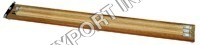
Comprising four constantan wires of 24 SWG, one meter long, clamped under heavy Brass strips of SWG 18 and fitted by screws in such a manner so that it is easily replaceable and has negligible "END ERRORS. Each block is fitted with a heavy lock type brass terminal which is mounted on an 18mm thick ply wooden board with mica on top. The four wires are stretched along the both ends of two full meter scales. Overall dimension: 1.12m x 100mm x 50mm high including terminals. Supplied complete with Pencil Jockey along with lead for connections & detailed working manual.
Versatile Mounting OptionsOffer flexibility with both panel mount and PCB mount designs, adapting seamlessly to various installation requirements. Whether upgrading existing equipment or developing new laboratory setups, the potentiometer fits a wide range of form factors, thanks to its standardized shaft dimensions and versatile shape options.
Precision and DurabilityEngineered for smooth operation and exceptional accuracy, this potentiometer features a high-precision build with long lifespan, boasting up to 15,000 rotational cycles. With a robust material composition, it performs reliably under demanding laboratory and industrial conditions, tolerating both high humidity and wide temperature ranges.
Adaptable for Multiple ApplicationsSuited for electronic circuits, volume adjustments, and calibration devices, this rotary potentiometer finds utility in laboratories, sound engineering, and instrumentation. The variable resistor function supports manual control over electrical parameters, offering dependable adjustability powered up to 1W and a maximum of 250V DC.
FAQ's of Potentiometer :
Q: How do I choose between single-turn and ten-turn potentiometer variants for my application?
A: Select single-turn potentiometers for quick adjustments and applications where a 270 rotation suffices, like simple volume or tone controls. Opt for ten-turn variants when precise or fine resistive adjustment is needed, such as in calibration devices or laboratory instruments.
Q: What is the installation process for this potentiometer on a PCB or panel mount?
A: For PCB mounting, align and solder the terminals to the board's specified locations. For panel mounting, insert the shaft through a prepared slot or hole, securing the unit with the provided nut or fastening mechanism. Always ensure the shaft alignment for optimal operation.
Q: When should I replace the potentiometer in my equipment?
A: Replace the potentiometer if you notice erratic adjustments, noise during rotation, or if you've exceeded the recommended 15,000 rotational cycles. Routine inspection in high-use environments extends the life of your electronic devices.
Q: Where can this potentiometer be optimally used?
A: It is ideal for laboratory equipment, electronic circuits, audio volume controls, and calibration instruments. The robust design and humidity tolerance make it suitable for both indoor lab and industrial settings across India.
Q: What benefits does the 10% resistance tolerance and low contact resistance variation provide?
A: The 10% resistance tolerance ensures consistency between units, supporting precise control applications. Contact resistance variation below 5% enhances signal integrity, delivering reliable readings for calibration and adjustment tasks.
Q: How does the material composition enhance the potentiometer's performance and durability?
A: Utilizing wood, conductive plastic, and a metal alloy wiper, the potentiometer offers smooth rotation, stable electrical contact, and resilience to environmental stressors such as humidity and temperature fluctuations, ensuring long operational life.







 English
 Spanish
 French
 German
 Italian
 Chinese (Simplified)
 Japanese
 Korean
 Arabic
 Portuguese


 Send Inquiry

