Product Description
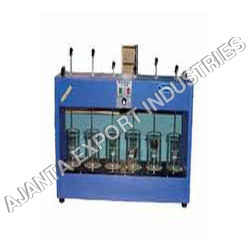
Estimate the dosing of alums & such other coagulants for treatment of water & effluent. Samples is easily viewed by diffused base illumination with florescent tube placed below plastic plate & black background. Fitted with D.C. motor of 1/20HP with variable speed upto 50-100 RPM controlled by speed regulator. Provided with stainless steel paddles with adjustable spacers to adjust the depth of paddles.
No. of Stirrers |
Two Stirrers |
Four Stirrers |
Six Stirrers |
This flocculator ensures each of the six samples receives uniform agitation with individually adjustable stirring rods made from stainless steel. The low-noise induction motor guarantees consistent performance below 55 dB, making it ideal for continuous, precise laboratory operation.
Simple and Accurate Digital ControlsA digital RPM controller and timer (up to 99 minutes) put power right at your fingertips. Effortlessly adjust stirring speed between 20-100 RPM and monitor progress on the digital display for repeatable, high-accuracy results every time you conduct a jar test.
Robust Construction With Superior Sample VisibilityBuilt with a powder-coated steel body and featuring backlit beaker support, this instrument allows optimal visibility of samples even under various lighting conditions. Durable borosilicate glass beakers and stainless steel rods ensure longevity and resistance to harsh lab conditions.
FAQ's of Flocculator Instrument:
Q: How do you operate the flocculator for laboratory jar testing?
A: To use the flocculator, place up to six borosilicate glass beakers containing your samples and coagulant under the stirring rods. Adjust the rod height as needed and set the desired speed (20-100 RPM) and timer (up to 99 minutes) using the digital controller. Start the test and use the backlight to observe floc formation.
Q: What specific benefit does the digital RPM controller provide?
A: The digital RPM controller allows you to precisely set and maintain stirring speeds with 2 RPM accuracy, ensuring consistent and reproducible results across all samples during water and wastewater analysis.
Q: When should the flocculator be used in water treatment processes?
A: The flocculator is typically used during the jar test stage of water and wastewater treatment to evaluate the performance and dosage of coagulants, helping optimize treatment efficacy before full-scale application.
Q: Where is the Laboratory Flocculator most effectively utilized?
A: This instrument is ideal for research, industrial, and municipal laboratories focused on water quality assessment and treatment optimization, especially where multiple parallel tests and visual evaluation of flocculation are required.
Q: What materials are used in the construction of the flocculator?
A: The instrument features an MS powder-coated steel body for durability, stainless steel stirring rods for corrosion resistance, and borosilicate glass beakers, which withstand high temperatures up to 120C.
Q: How does the adjustable height stirring paddle enhance the flocculator's usage?
A: Adjustable paddle heights allow users to tailor mixing intensity to sample volume and viscosity, resulting in uniform mixing and improved floc formation, crucial for accurate jar test results.







 English
 Spanish
 French
 German
 Italian
 Chinese (Simplified)
 Japanese
 Korean
 Arabic
 Portuguese


 Send Inquiry

