Product Description
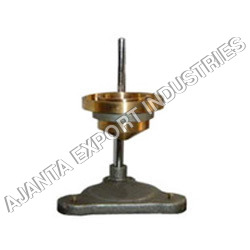
Flow cup viscometer (ford cup)flow cup viscometer with stand (ford cup) B-4 made of brass flow cup viscometer with stand (ford cup) b-2, b-3, b-5, b-6, b-7, b-8, spare cup for above flow cup viscometer (ford cup) B-4, made of brass with certificate zahn viscometer cup no. 1, 2, 3, 4 & 5 with handle.Precision Flow MeasurementEngineered for laboratory use, this Flow Testing Instrument offers accurate flow measurement and testing for water and light fluids between 0.2 to 2.5 L/min. The ISO-certified system delivers reliable results with an accuracy of +/- 0.5%, ensuring critical processes are maintained within tolerance requirements.
Robust and Versatile ConstructionConstructed from stainless steel, borosilicate glass, and mild steel, the instrument is both durable and transparent for easy visual observation. Corrosion resistance and a bench-top design make maintenance minimal, and its standard hose fittings simplify installation across laboratory environments.
Easy Operation and MaintenanceWith an analog display and manual controls, users can intuitively measure and adjust flow rates. Low maintenance requirements ensure streamlined operation, while the transparent cell allows direct fluid monitoring, helping laboratory staff conduct tests efficiently and safely.
FAQ's of Flow Testing Instruments:
Q: How does the Flow Testing Instrument measure fluid flow accurately?
A: The instrument employs manual controls paired with an analog display to measure and monitor flow rates with precision. Its advanced design uses borosilicate glass for visibility and stainless steel for reliability, ensuring accuracy within +/- 0.5% for water and light fluids.
Q: What types of fluids are compatible with this flow testing device?
A: This instrument is designed specifically for water and light fluids, making it ideal for laboratory experiments and testing scenarios requiring clean, non-corrosive samples.
Q: Where is this Flow Testing Instrument most effectively used?
A: Primarily recommended for fluid mechanics laboratories, research centers, and educational institutions where dependable flow measurement and testing are essential for experiments and demonstrations.
Q: What is the process for installing the Flow Testing Instrument?
A: Installation is straightforward due to the standard hose fittings and bench-top mounting. Simply connect the device to the water or light fluid source, secure it on the laboratory bench, and plug it into a 220V AC power supply.
Q: How does the low maintenance benefit laboratory staff?
A: The combination of corrosion-resistant materials and simple manual controls reduces time spent on upkeep, minimizing disruption and allowing staff to focus on experimental work rather than maintenance.
Q: What safety features support its use during fluid testing?
A: The transparent borosilicate glass body lets users visually monitor fluid movement, minimizing risks of overflow or improper flow rate, while the sturdy construction ensures the instrument remains safe during extended use.







 English
 Spanish
 French
 German
 Italian
 Chinese (Simplified)
 Japanese
 Korean
 Arabic
 Portuguese




 Send Inquiry

