Product Description
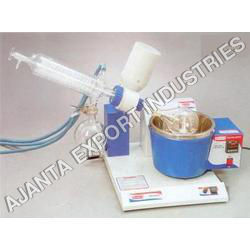
We offer Rotary Vacuum Evaporator that has unit base made of thick M.S sheet coated with a layer of epoxy based polyester paint providing a scratch less & chemical resistant surface. General drive unit offers a smooth speed rotation precisely controlled with analog knobs. Double walled bath-seamless inner vessel SS 304 & outer AL, provided with high grade insulation to eluminate heat loss.
Digital temperature indicator cum controller,temperature control from ambient plus 5
0 C to 180
0 C.
Designed for Laboratory ExcellenceWith its robust construction from borosilicate glass, stainless steel, and PTFE, this rotary vacuum evaporator is built to deliver dependable results in laboratory settings. Its modular design supports various flask sizes and customizable condenser types, offering both flexibility and efficiency to laboratories engaged in distillation, concentration, and drying tasks. The chemical-resistant materials ensure long-term reliability and effectiveness.
Precision and Safety in Every OperationThe evaporator features a digital PID controller, touch panel, or push button interfaces, granting precise management of temperature and rotational speed. Overheat and dry-run protection, along with a safety cutoff and anti-explosion features, prioritize user safety during operation. With the ability to operate up to 250C and a vacuum range reaching 399.9 mbar, it reliably handles demanding laboratory protocols.
Flexible and Efficient Laboratory ApplicationSuitable for laboratories of all sizes, this rotary vacuum evaporator can be supplied with rotary and receiving flask capacities ranging from 1L to 50L. Interchangeable glassware and vertical or diagonal condensers accommodate a range of solvents and applications, ensuring adaptability and efficiency for both research and industrial processes.
FAQ's of Rotary Vacuum Evaporator:
Q: How does the high-performance PTFE seal enhance vacuum retention in the rotary vacuum evaporator?
A: The high-performance PTFE seal provides a tight, chemical-resistant barrier at critical joints, significantly reducing vacuum loss during operation. This ensures efficient solvent evaporation under reduced pressure and enhances the reliability of the process.
Q: What types of condensers are available, and how should I select the right one for my application?
A: The evaporator offers double or vertical coil condensers. Double condensers are ideal for high-throughput solvent recovery, while vertical coil types are suited for standard distillation. Selection depends on your specific laboratory workflow and distillation requirements.
Q: When should I use a manual versus a motorized lift mechanism?
A: A manual lift is recommended for routine, small-volume applications, offering cost efficiency and simplicity. Opt for a motorized lift for larger-scale or repetitive processes, as it provides enhanced convenience and precise control, particularly when handling heavy flasks.
Q: Where can the rotary vacuum evaporator be installed, and what setup considerations are important?
A: This equipment is designed for laboratory environments with adequate space, proper ventilation, and access to single-phase power (220-380 V). Ensure the setup location supports handling of solvent vapors, and provides a stable, level surface for safe operation.
Q: What is the typical process for solvent distillation using this rotary vacuum evaporator?
A: First, fill the rotary flask with your solution and secure it in place. Select the appropriate condenser and flask size, then set temperature and speed using the digital control interface. Engage the vacuum, begin rotation, and monitor evaporation until completion, after which the concentrated residue can be collected safely.
Q: What safety features protect users during operation?
A: This rotary evaporator includes overheat protection, dry-run protection, and an automatic safety cutoff. Additionally, anti-explosion and chemical-resistant designs, along with a noise level below 60 dB(A), provide a safe working environment for laboratory staff.
Q: What are the key benefits of using a rotary vacuum evaporator with advanced digital PID control and glassware interchangeability?
A: The digital PID control ensures precise temperature and speed regulation, improving reproducibility and product quality. Interchangeable glassware accommodates diverse experimental needs, making the system highly adaptable and cost-effective for multiple applications in research or production settings.







 English
 Spanish
 French
 German
 Italian
 Chinese (Simplified)
 Japanese
 Korean
 Arabic
 Portuguese


 Send Inquiry

