Product Description
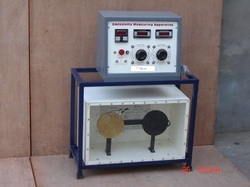
The present Set-up is designed to measure the emissivity of test plate. The test plate comprises of a mica heater sandwiched between two circular plates. Black plate is identical with test plate, but its surface is blackened. As all the physical properties, dimension and temperature are equal; heat losses from both plates will be same except radiation loss. Hence the input difference will be due to difference in emissivity. Both plates are supported on individual brackets in a wooden enclosure with one side glass to ensure steady atmospheric conditions. Temperature Sensors are provided to measure the temperature of each plate and surrounding. Supply is given to heaters through separate variacs so that temperatures of both can be kept equal and is measured with Digital Voltmeter and Digital Ammeter.
Experiments
- Determining the Emissivity of a test plate.
- Study the variation of emissivity of test plate with respect to absolute temperature.
Utilities Required
- Electricity Supply: 1Phase, 220 VAC, 4 Amp.
- Table for set-up support
High Precision Stainless Steel ConstructionEach Emissivity Measurement Apparatus is made from robust stainless steel, ensuring resistance to corrosion and longevity. Engineered for laboratory settings, the apparatus provides stable and consistent measurements, which are crucial for scientific experiments. Its solid build supports frequent use and easy maintenance.
Flexible Voltage and Temperature AccommodationsOperating seamlessly within a voltage range of 110-220V, this device accommodates most laboratory power systems found globally. With a working temperature range between 30C and 80C, it allows precise emissivity assessments across multiple research and testing scenarios.
FAQ's of Emissivity Measurement Apparatus:
Q: How is the Emissivity Measurement Apparatus used in laboratories?
A: The apparatus is used to determine the emissivity of various materials by measuring the thermal radiation emitted. It is commonly employed in thermal and material science laboratories to support experiments regarding heat transfer properties.
Q: What are the main benefits of using stainless steel for this apparatus?
A: Stainless steel provides excellent durability, resists corrosion, and maintains structural integrity under temperature variations. This ensures accurate and consistent measurements over repeated uses.
Q: When should the Emissivity Measurement Apparatus be calibrated?
A: Calibration should be performed regularly, preferably before a new set of experiments, to maintain measurement accuracy-especially if the apparatus has been moved or subjected to significant temperature changes.
Q: Where can this apparatus be utilized effectively?
A: It is ideal for use in educational institutions, university research labs, and industrial laboratories where emissivity testing and material characterization are essential.
Q: What is the process involved in measuring emissivity with this apparatus?
A: A sample material is placed in the apparatus, which is then heated within the specified temperature range. The emitted thermal radiation is measured, and the emissivity value is calculated using the device's sensors and controls.
Q: How does the voltage range of 110-220V benefit laboratory users?
A: The wide voltage compatibility allows users in different regions to operate the apparatus without the need for specialized converters or adapters, enhancing convenience and flexibility.







 English
 Spanish
 French
 German
 Italian
 Chinese (Simplified)
 Japanese
 Korean
 Arabic
 Portuguese


 Send Inquiry

