Product Description
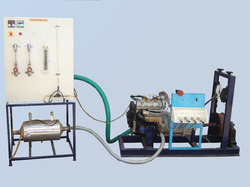
The setup consists of four cylinders, four stroke, Diesel engine connected to dynamometer for engine loading. The setup has stand-alone type independent panel box consisting of air box, fuel tank, manometer, fuel measuring unit. Engine jacket cooling water inlet, outlet and calorimeter temperature is displayed on temperature indicator. Flowmeters are provided for cooling water and calorimeter flow measurement.
Experiments
- Study of engine performance for power, efficiencies, fuel consumption, air fuel ratio and heat balance
Utilities Required
- Electric supply Provide 230 +/- 10 VAC, 50 Hz, single phase electric supply with proper earthing. (Neutral Earth voltage less than 5 VAC)
- 5A, three pin socket with switch (2 No)
- Water supply Continuous, clean and soft water supply @ 4000 LPH, at 10 m. head. Provide tap with 1 BSP size connection
- Space 3500Lx4000Wx2000H in mm
- Drain Provide suitable drain arrangement (Drain pipe 65 NB/2.5 size)
- Exhaust Provide suitable exhaust arrangement (Exhaust pipe 32 NB/1.25 size)
- Fuel, oil Diesel @10 liter, Oil @ 3.5 lit. (15W40)
Advanced Instrumentation and MeasurementThis test rig incorporates digital displays for all key parameters-engine RPM, torque, temperature, fuel flow, and air flow-which allow for real-time data monitoring. Direct burette method and electronic sensors provide high accuracy in fuel measurement. The system further extends its capabilities with PC connectivity via USB or RS485, making logging and analysis straightforward and suitable for laboratory or industrial environments.
Comprehensive Safety and DurabilityEngineered with multiple safety features including over-temperature cutoff, emergency shutdown, and a robust metallic enclosure with safety interlocks; the rig minimizes operational risk. Vibration isolation mounts, heavy-duty heat-resistant cladding, and corrosion-resistant piping ensure prolonged service life and reliable performance-even under high temperature (up to 120C) and pressure (up to 8 Bar) conditions.
Flexible and Efficient Testing CapabilitiesWith options for eddy current or hydraulic dynamometers and a closed-loop cooling system, this rig can conduct a variety of essential engine tests: brake and indicated power, mechanical efficiency, heat balance, fuel economy, and emissions. The test rig's mobility, with castor wheels and a dedicated engine cradle, enhances usability, while comprehensive accessories support both routine and advanced testing requirements.
FAQ's of 4 Cylinder 4 Stroke Diesel Engine Test Rig:
Q: How does the 4 Cylinder 4 Stroke Diesel Engine Test Rig measure engine performance?
A: The rig uses a digital display system and compatible sensors to monitor parameters such as RPM, torque, fuel flow, air flow, and temperature. Measurement of brake power, indicated power, and mechanical efficiency is facilitated by an eddy current or hydraulic dynamometer, while fuel consumption is gauged through direct burette or electronic sensor methods.
Q: What process should be followed for cooling the engine during testing?
A: The rig employs a closed-loop cooling system with a heat exchanger and corrosion-resistant piping. This system circulates coolant efficiently, maintaining engine temperature within safe limits (up to 120C), and can be controlled through ball and solenoid valves placed strategically for optimal thermal management.
Q: When should routine maintenance be performed on the test rig?
A: Routine maintenance should be conducted after a set number of test cycles or as advised in the operating manual. Key maintenance activities include checking the integrity of pressure and fuel lines, inspecting safety interlocks and emergency stop functions, verifying calibration of digital sensors, and ensuring the cooling system is free from obstructions.
Q: Where can the test rig be installed and used?
A: This diesel engine test rig is primarily intended for laboratory settings, research institutions, and technical training centers. Its robust construction, compliance with ISO and Indian standards, and easy mobility with castor wheels allow installation in educational, industrial, or research environments.
Q: What are the key benefits of using PC connectivity for data acquisition?
A: PC connectivity (via USB or RS485) enables automated logging, analysis, and export of test data. It provides advanced capabilities for monitoring trends, generating reports, and sharing results, making the rig suitable for both educational demonstration and in-depth research applications.
Q: How do the safety features enhance the reliability of this test equipment?
A: The test rig is equipped with over-temperature cutoff, automatic shutdown, emergency stop button, and a safety interlock-protected heavy-duty door. These features help protect both operators and the equipment during abnormal operating conditions, reducing risks associated with temperature and pressure excursions.







 English
 Spanish
 French
 German
 Italian
 Chinese (Simplified)
 Japanese
 Korean
 Arabic
 Portuguese


 Send Inquiry

