Product Description
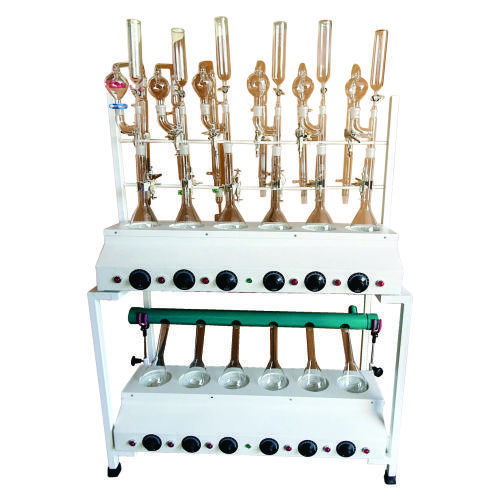
Kjeldahl Digestion & Distillation Units
Units of 3 tests (Heater Type)
Units of 6 tests (Heater Type)
Units of 3 tests (Mantle Type)
Units of 6 tests (Mantle Type)
OPTIONAL KJELDAHL DIGESTION &DISTILLATION UNITS (Combined)
Glass part for 3 unit.
Glass part for 6 unit.
Note : All above units are without glass parts.
Versatile Construction for Durability and PerformanceThe units employ a powder-coated mild steel exterior and a stainless steel 304 inner chamber, offering superior protection against chemical corrosion. The cast aluminium or stainless steel digestion block and acid/alkali proof piping ensure long-term device integrity, while the mineral wool or glass wool insulation maintains stable high temperatures for reliable analysis.
Precise and Safe Laboratory OperationDesigned for precision, these units feature uniform heating up to 450C, over-temperature cut off, and efficient fume removal systems. The inclusion of analog or digital temperature indicators along with acid and alkali resistant stopcocks, swing door with heat-resistant handle, and water cooling for condensers guarantee safe, accurate, and convenient laboratory usage.
Efficient Nitrogen and Protein AnalysisIdeal for research or industrial labs, the combined digestion and distillation unit efficiently handles nitrogen and protein analysis via the Kjeldahl method. The system's multi-sample capacity, manual parameter recording, and comprehensive accessories facilitate timely and accurate results, supporting batch processing to boost laboratory productivity and compliance.
FAQ's of Kjeldahl Digestion & Distillation Units:
Q: How does the Kjeldahl Digestion & Distillation Unit operate for protein or nitrogen analysis?
A: The unit performs sample digestion and distillation as per the Kjeldahl method. Samples are heated in the SS-304 chamber using uniform heating blocks. Subsequent distillation, aided by the condenser and receiver flask, ensures accurate measurement of nitrogen or protein content. The process is precisely monitored via an analog or digital temperature display.
Q: What materials are used in the construction of this unit and why?
A: The exterior is powder-coated mild steel for durability, while all interior parts in contact with chemicals, including the chamber and piping, are stainless steel 304 or acid/alkali resistant. This selection ensures high strength, corrosion resistance, and chemical compatibility, crucial for laboratory standards and performance longevity.
Q: When is it necessary to use water circulation in the system?
A: Water circulation is essential during the distillation phase to cool vapors in the condenser. This ensures effective condensation, preventing vapor loss and safeguarding the integrity of your analysis results. Continuous water flow also helps maintain the safety and operational stability of the unit during extended use.
Q: Where can this Kjeldahl unit be installed or operated?
A: This unit is designed for laboratory environments, such as research institutions, quality control labs, food processing industries, or academic settings across India. The compact size (600 400 900 mm) allows easy integration onto a laboratory bench or trolley, providing flexibility for diverse setups.
Q: What benefits does the fume duct with suction facility provide?
A: The integrated fume duct, equipped with suction, efficiently removes hazardous fumes produced during sample digestion. This feature not only enhances laboratory safety by minimizing exposure to toxic gases but also maintains a cleaner working environment, complying with health and safety standards.
Q: How is overheating prevented during operation?
A: The unit is equipped with an over-temperature cut off, which automatically interrupts power supply if the preset temperature threshold is exceeded. This critical safety function protects both users and samples, ensuring reliable and uninterrupted operation within the specified temperature range.
Q: Can different sample capacities be accommodated in the same unit?
A: Yes, the system offers configurations for either 6 or 12 sample tubes (each with 300 ml or 500 ml capacity), allowing the operator to select based on lab throughput needs. The modular chamber and trolley design provide flexibility for varying batch sizes without sacrificing efficiency or accuracy.







 English
 Spanish
 French
 German
 Italian
 Chinese (Simplified)
 Japanese
 Korean
 Arabic
 Portuguese


 Send Inquiry

