Product Description
Salient Features
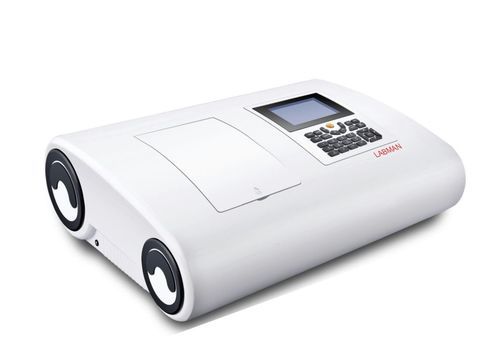
| The two detectors are used to measure sample and reference respectively and simultaneously for optimizing measurement accuracy. |
| Lamp selection enables conserving the life of D2 & Tungsten lamnps. Real time clock for date & time stamping of results. |
| LIGHT PATH DESIGN: DOUBLE BEAM LMSP-UV1900 double light design can prevent circuit fluctuation and stray light to ensure stability of the instrument. |
| LONG PATH LIGHT DESIGN LMSP-UV1900 unique 520mm long light path design greatly improved resolution and the bandwidth can reach 0.5nm. |
| 16MM OPTICAL BASE LMSP-UV1900 series use a rigid 16mm diecast aluminum base as their optical mount to ensure the stability and reliability. |
| 6 INCHES LCD DISPLAY LMSP-UV1900 series have a 6 inches LCD display to show results and curves directly on the screen. |
| SOFTWARE FUNCTIONS ( (optional) Multi functions operated directly on the spectrophotometer and display the test results' curve and data: wavelength scanning, standard curve, kinetics, multi wavelength scanning, DNA/protein test. |
| PERFECT CALIBRATION SYSTEM All baseline, wavelength, dark current can be calibrated automatically to keep good running conditions. |
| DATA OUTPUT LMSP-UV1900 series are equipped with USB port to connect with a PC ( software optional ) comes standard with the instrument. |
Precision and Range for Advanced ResearchThis spectrophotometer supports precise analyses with a wavelength accuracy of 0.3 nm and a photometric range from -0.3 to 3.0 Abs. Its double beam optics and spectral bandwidth of 2 nm ensure reliable, repeatable measurements, suiting advanced research needs in chemistry, biochemistry, and environmental science. The wide wavelength range accommodates diverse analytical requirements.
User-Friendly Operation and ConnectivityThe microprocessor-based control system, large LCD display, and automatic wavelength setting simplify operation. Multiple scan speeds are selectable to match varied application needs, while data can be stored internally or exported via USB/RS232. This spectrophotometer integrates easily with laboratory workflows and is compatible with most printers for immediate result documentation.
Robust Design for Laboratory ApplicationConstructed from ABS plastic and metal, the spectrophotometer is built for durability and safety in demanding lab settings. The 4-position quartz cuvette holder supports efficient sample processing, and the system operates reliably under ambient conditions. Its compact rectangular shape and manageable weight facilitate convenient installation and use.
FAQ's of Double Beam UV-VIS Spectrophotometer:
Q: How does the double beam design enhance measurement accuracy in this UV-VIS spectrophotometer?
A: The double beam design compares sample and reference beams simultaneously, minimizing fluctuations from the light source or environment and providing more stable and accurate absorbance measurements compared to single beam models.
Q: What is the process for selecting wavelength and scan speed during analysis?
A: Users can set the desired wavelength automatically using the microprocessor-based control and large LCD display. Scan speed (fast, medium, or slow) is selectable prior to measurement, optimizing data collection for the sample type and application.
Q: When should the spectrophotometer's quartz cuvettes be used?
A: Quartz cuvettes are ideal for UV and visible range measurements, ensuring accurate light transmission from 190 to 1100 nm. Use them whenever analyzing samples in laboratory, pharmaceutical, or environmental research applications.
Q: Where can the collected measurement data be stored or exported?
A: Measurement data can be stored internally within the spectrophotometer's memory or exported to a PC via USB or RS232 interface. The system also supports direct connection to compatible printers for physical result output.
Q: What benefits does automatic wavelength setting provide?
A: Automatic wavelength setting reduces manual setup errors, improves repeatability between analyses, and streamlines workflow efficiency, saving time during routine laboratory measurements.
Q: How is baseline stability maintained in extended experiments?
A: Baseline flatness of 0.001 Abs ensures minimal drift over time. The instrument's double beam optics and robust light sources (Deuterium & Tungsten lamps) work together to maintain consistent baseline stability during prolonged usage.







 English
 Spanish
 French
 German
 Italian
 Chinese (Simplified)
 Japanese
 Korean
 Arabic
 Portuguese


 Send Inquiry

