Product Description
Product Description
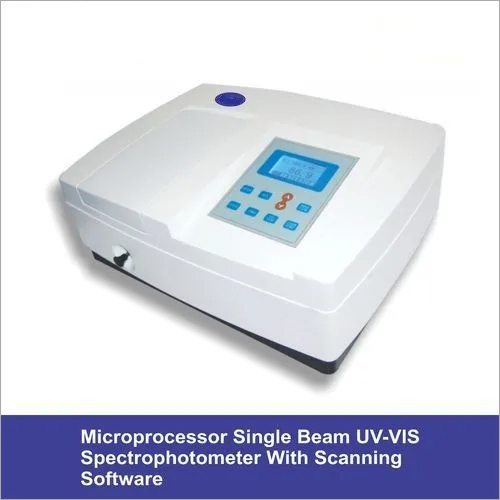
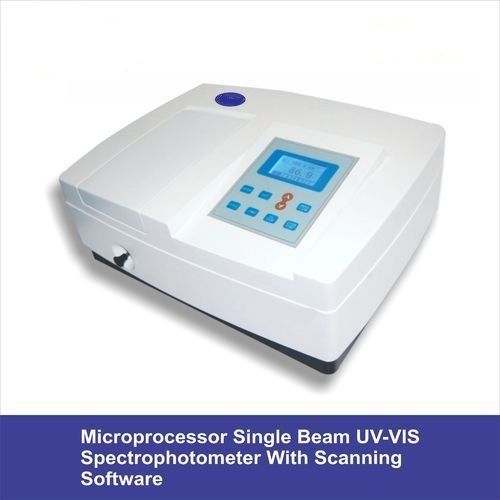
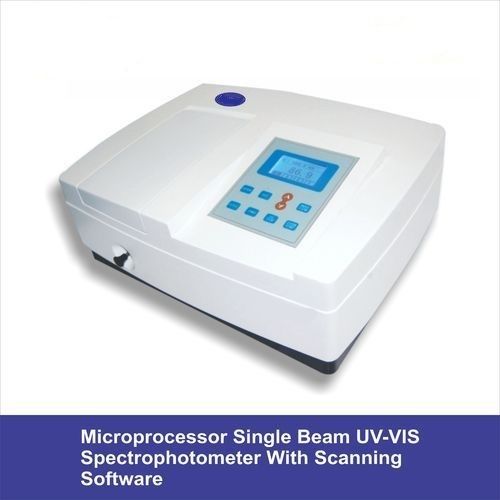
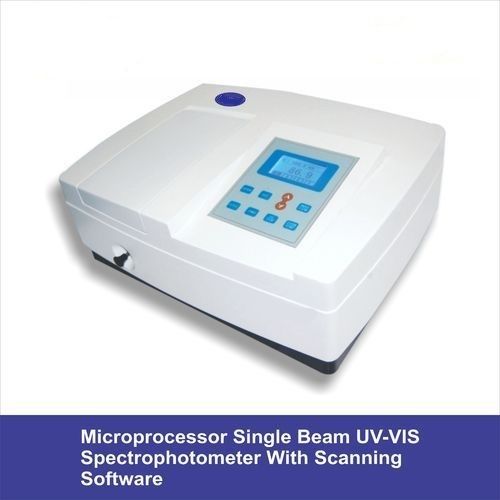
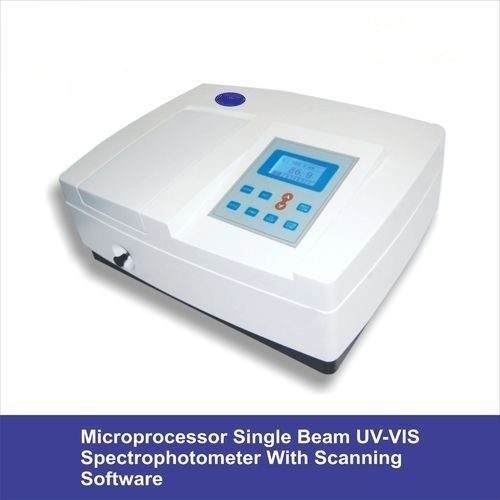
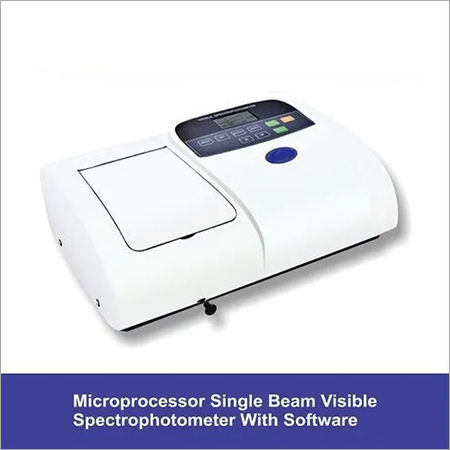
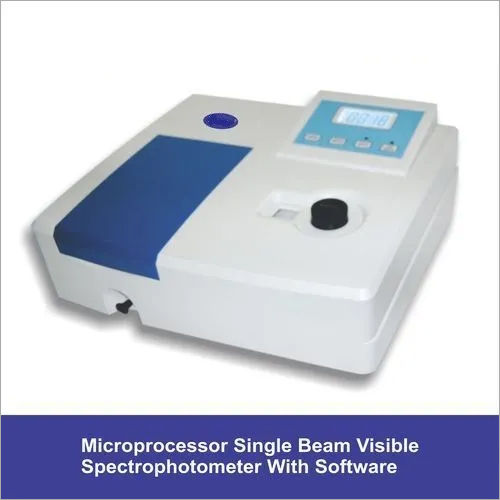
Being a well-establishedorganization, we are engaged in offering a distinguished range of MicroprocessorUV-VIS Single Beam Spectrophotometer.
ProductSpecification
| Wavelength Range | 190-1000 nm |
| Type | Non Portable |
| Model | Aei-As-Rt110 |
| Application | Industrial Use |
| Brand | AjantaExports |
| Band width | 2 nm |
| Data Output Port | USB |
| Lamps | D2 Lamp & Tungston Lamp |
| Detector | Silicon Photodiode |
| Dimension | 420 x 280 x 180 mm |
| Display | 128 * 64 Dots LCD |
| Light Source | Tungsten & Deuterium lamp |
| Net | 13.00 Kg |
| Output | USB Port & Parallel Port (Printer) |
| Photometric Accuracy | +/-0.5 % T |
| Photometric Range | -0.3-3 A, 0-200 % T |
| Photometric Repeatability | 0.3 % T |
| Power Requirements | AC 85 - 250 v |
| Price | 1665 USD |
| Stability | +/-0.002 A/h In 500 Nm |
| Standard Cell Holder | 4-position 10mm cell changer |
| Stray Light | Less than 0.3 % T |
| Wavelength Accuracy | +/- 1 nm |
| Wavelength Repeatability | 0.5 nm |
| Wavelength Setting | Auto |
| Weight | 16.950 Kg |
| Minimum Order Quantity | 1 Piece |
Precision and Accuracy for Laboratory ExcellenceThis spectrophotometer offers outstanding wavelength and photometric accuracy, ensuring dependable analytical results. Its spectral coverage and sensitive silicon photodiode detector make it suitable for a variety of applications, from routine testing to research-oriented analysis. The robust construction and reliable light source contribute to consistent performance over long-term use.
Efficient Operation with Advanced FeaturesWith an integrated microprocessor and spectrum scanning software, users benefit from user-friendly operation, data storage, and flexible scanning modes (fast, medium, slow). The USB interface allows seamless connection to a PC, while the large LCD display provides clear visualization of results, enhancing workflow efficiency in demanding laboratory environments.
Versatility and Wide Application RangeDesigned for versatility, this single beam UV-VIS spectrophotometer accommodates applications in pharmaceuticals, chemicals, environmental analysis, and academia. Its ability to deliver highly accurate measurements in ambient laboratory conditions makes it an indispensable tool for quality control and research tasks.
FAQ's of Advanced Microprocessor UV-VIS Single Beam Spectrophotometer with scanning softwere:
Q: How do I set up and operate the Advanced Microprocessor UV-VIS Single Beam Spectrophotometer?
A: To set up the spectrophotometer, place it on a stable laboratory bench, connect to an AC mains power supply (220 V 10%, 50 Hz), and install the cuvette (preferably quartz for UV measurements). The microprocessor-controlled design and large LCD display guide you through initialization and measurements. The user-friendly software supports spectrum scanning, data storage, and easy retrieval of results.
Q: What materials can the spectrophotometer analyze within its wavelength range?
A: This spectrophotometer is suited for analysis of a wide array of samples, including organic, inorganic, and biological compounds, as long as they absorb within the 190-1100 nm wavelength range. Its versatility covers applications in pharmaceutical quality control, chemical analysis, environmental testing, and academic research.
Q: When should I perform calibration or maintenance on the spectrophotometer?
A: Routine calibration is recommended before critical measurements and periodically as specified in the instrument manual. Regular maintenance-such as cleaning the optical path, replacing deuterium or tungsten halogen lamps, and verifying baseline flatness-ensures sustained accuracy and reliable operation.
Q: Where can the spectrophotometer be effectively used?
A: This device is intended for controlled laboratory environments with ambient temperature (5-35C) and relative humidity 85%. It is widely used in university labs, industrial research facilities, quality assurance departments, and pharmaceutical laboratories.
Q: What is the process for transferring and storing spectral data?
A: With integrated USB and RS232 data outputs, users can transfer spectral and analytical data to computers or network storage for further processing. The included advanced scanning software simplifies data management, enabling efficient recording, storage, and analysis of results.
Q: How does spectrum scanning benefit laboratory analysis?
A: Spectrum scanning allows users to record absorbance or transmittance values across a specified wavelength range, identifying sample peaks and providing vital information about composition and concentration. This capability accelerates both routine and in-depth research analysis.
Q: What are the advantages of using this spectrophotometer for quantitative and qualitative analyses?
A: Its high accuracy, low stray light, adjustable scanning speeds, and advanced software deliver precise, reproducible results. The robust build ensures durability, while the broad wavelength range and versatile application make it a valuable asset for comprehensive laboratory testing.







 English
 Spanish
 French
 German
 Italian
 Chinese (Simplified)
 Japanese
 Korean
 Arabic
 Portuguese


 Send Inquiry

