Product Description
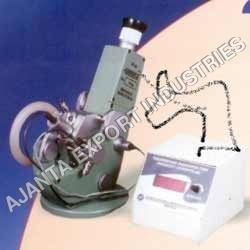
With the aid of our procuring agents we are offering our clients sustainable range of Abbe Refractometer. The product we are offering determines Refractive Index & Dispersion Properties of Solids & Liquids. R.I.Scale: 1.3000 1.7100, Accuracy: 0.001 or 0.0005 (direct Reading) and Sugar Scale: 0.95%, Accuracy:0.5%(Direct Reading).
Features:
High-Precision Optical MeasurementEngineered for precise refractive index and Brix analysis, the Abbe Refractometer provides measurement resolutions up to 0.0001 RI and 0.1% Brix. The optical glass prisms paired with a calibrated analog scale ensure accurate readings, establishing confidence in research and industry environments.
Manual Operation-No Power RequiredThis Abbe Refractometer is designed for full manual use, drawing on ambient light or an optional external lamp for illumination. With no electronic components or external power supply needed, it is ideal for laboratory settings where dependability and portability are essential.
User-Friendly Calibration and Temperature ControlCalibration can be easily performed with known standards through a simple manual process. The integrated glass thermometer monitors samples from 0 to 100C, supporting temperature-sensitive measurements and ensuring consistent, reproducible results every time.
FAQ's of Abbe Refractometer:
Q: How do I calibrate the Abbe Refractometer for accurate readings?
A: Calibration is accomplished manually using a standard reference liquid with a known refractive index or Brix value. Place a small amount (0.1-0.5 ml) on the prism, adjust the scale to match the reference value, and the instrument is ready for precise measurement.
Q: What types of samples can be measured with this refractometer?
A: The device can measure both liquids and solids for refractive index and Brix content, making it suitable for laboratory, quality control, food industry, and educational applications.
Q: Where is the Abbe Refractometer best used?
A: This instrument is ideal for laboratory settings in research institutions, food and beverage production, chemical analysis labs, and educational environments where reliable, electricity-free measurements are needed.
Q: What benefits does the manual operation provide?
A: Manual operation ensures measurement accuracy without reliance on electricity, allowing use in locations without power supply. It also promotes ease of maintenance and durability due to the absence of electronic parts.
Q: When should temperature be controlled during measurement?
A: Temperature affects refractive index readings, so the built-in thermometer helps users monitor and control sample temperature-especially useful when working near the maximum temperature resistance of 100C or when high precision is required.
Q: How does the viewing alignment system improve measurement accuracy?
A: The eyepiece features a crosshair for precise sample alignment, which helps users accurately determine the endpoint on the analog scale, reducing user error and improving reproducibility.
Q: What is the process for taking a measurement with this device?
A: To measure, apply the sample between the glass prisms, look through the eyepiece, align the sample using the crosshair, and read the value off the analog scale. For best results, calibrate before use and ensure sample temperature is noted.







 English
 Spanish
 French
 German
 Italian
 Chinese (Simplified)
 Japanese
 Korean
 Arabic
 Portuguese


 Send Inquiry

