Product Description
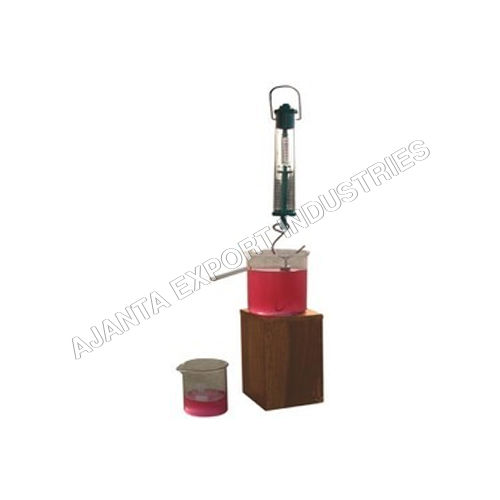
Polystyrene bodies with large, easily read flat scales, zero adjustable device having anodized metal scale is provided.
| | Capacity | Subdivision |
| A | 100 | 1 |
| B | 200 | 2 |
| C | 250 | 2.5 |
| D | 500 | 5 |
| E | 1000 | 10 |
| F | 2000 | 20 |
Versatile Measurement for Laboratories and Field UseSpring Balances offer accurate measurement of force, tension, and weight, making them essential in laboratories, educational settings, and field applications. With varying capacities and compact dimensions, these balances are suitable for a broad range of experiments and practical demonstrations.
Durable and User-Friendly DesignBuilt with a stainless steel internal spring and housed in robust plastic or metal casing, the Spring Balance ensures longevity and resistance to corrosion. Clear analog graduations and non-slip hooks add to user safety and convenience, while manual control means no need for electrical power.
FAQ's of Spring Balance:
Q: How do you use a Spring Balance to measure weight or force?
A: To measure weight or force with a Spring Balance, attach the object to the non-slip stainless steel hook and read the value indicated by the pointer on the analog scale. Make sure the balance is set to zero before use by adjusting the zero knob if necessary.
Q: What benefits does the Spring Balance offer over electronic alternatives?
A: Spring Balances are portable, easy to use, and do not require batteries or electrical power. They have a simple manual operation and are factory calibrated for reliable results. Their corrosion-resistant construction adds durability for prolonged usage in various environments.
Q: When should recalibration or zero adjustment be performed?
A: Zero adjustment should be performed before each use to ensure accuracy. Recalibration is generally unnecessary due to factory settings but should be considered if the balance has undergone significant impact or if readings appear inaccurate.
Q: Where are Spring Balances typically used?
A: These balances are commonly found in laboratories, educational institutions, and for field measurements in research or quality control applications. Their portability and manual operation make them suitable for use where electrical power isn't available.
Q: What process ensures the Spring Balance remains accurate over time?
A: Regularly check the zero setting before each use and avoid exceeding the maximum load capacity. Prevent exposure to extreme temperatures or corrosive environments. Proper handling and storage also help maintain accuracy and prolong the life of the device.
Q: How do safety features enhance the Spring Balance's usage?
A: Safety features such as non-slip hooks and overload protection (on select models) reduce the risk of accidents, equipment damage, or inaccurate readings, making the device safer and more reliable for routine measurements.








 English
 Spanish
 French
 German
 Italian
 Chinese (Simplified)
 Japanese
 Korean
 Arabic
 Portuguese




 Send Inquiry

