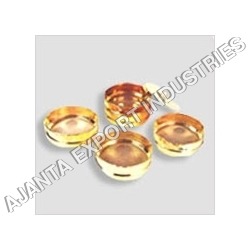
Manufactured from robust and highly polished brass, our round sieves deliver exceptional accuracy for particle separation and sample analysis. The manual operation allows users to control the sieving process effectively, ensuring reliable and reproducible results. Suitable for laboratories, research centers, and industrial uses, these sieves are designed for consistent performance in testing and quality assurance.
FAQ's of Sieves:
Q: How are brass round sieves used in laboratory and industrial settings?
A: Brass round sieves are used to separate, classify, and analyze particle sizes within a sample. Commonly employed in laboratories and industrial facilities, they are placed over collection containers, and the sample material is manually agitated or shaken, allowing precise particle separation for research or quality control purposes.
Q: What benefits do brass sieves offer over other materials?
A: Brass sieves provide excellent durability, corrosion resistance, and a polished finish, making them easy to clean and maintain. Their non-reactive properties ensure sample integrity, making them ideal for sensitive laboratory and research applications.
Q: When should I use a manual brass sieve instead of automated equipment?
A: Manual brass sieves are most suitable for small to medium sample sizes, scenarios requiring hands-on control, or when budget or space limitations exist. They are ideal for educational institutions, research projects, or quality assurance checks that do not require large-scale automation.
Q: Where are these brass sieves typically manufactured and supplied from?
A: Our brass round sieves are manufactured, exported, supplied, and traded from India, adhering to internationally recognized laboratory and industrial standards for high performance and reliability.
Q: What is the process for cleaning and maintaining brass sieves?
A: After use, gently tap or brush off residual material, rinse with mild detergent and warm water, and dry thoroughly. Avoid abrasive materials to protect the polished frame. Proper maintenance ensures longevity and consistent performance.
Q: How does the polished brass frame benefit laboratory work?
A: The polished brass frame resists corrosion, reduces sample contamination risks, and provides a smooth surface aiding thorough cleaning, thereby ensuring accurate and uncontaminated test results in laboratory environments.
Q: What typical applications do these sieves serve in research and industry?
A: Brass sieves are used in particle size analysis, material separation, soil testing, and sample preparation for quality control in laboratories, research institutions, and various industries including pharmaceuticals, chemicals, and construction.







 English
 Spanish
 French
 German
 Italian
 Chinese (Simplified)
 Japanese
 Korean
 Arabic
 Portuguese



 Send Inquiry

