Product Description
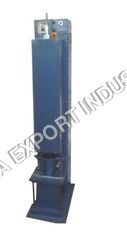
It is a motor driven mechanical compactor useful to compact 152 mm Dia moulds. It is fitted with a compaction rammer of 10.2 Kg with a free fall of 457 mm. The rammer assembly is to be attached with a ratchet and pawl arrangement to lift it from the top of the test samples. When the rammer reaches the required height, the pawl releases the rammer, which falls freely on the test specimen. The release mechanism is connected by an arm moving up and down, which is connected to a reduction gear coupled to the motor through another arm. An automatic Electronic blow counter is used to set the desired number of blows. The Compactor is supplied complete with wooden pedestal. Suitable to work on 230 V, 50 Hz, ACc Single Phase. Supplied with Test Report and Instructions Manual.
Make : AEI.
As Per ASTM D 5581-06.
This equipment is to speed up the process to cylindrical specimens for Marshall Stability Testing Machine with ease and accuracy. The compactor has been designed to simulate hand compaction as described in ASTM D 1559. This machine compact the samples automatically and stops when desired preset numbers of blows have been completed. The compactor gives uniform and accurate marshall moulds for reliable testing.
Effortless and Accurate Laboratory CompactionThis Automatic Marshall Molds Compactor streamlines sample preparation by automating the compaction process. Featuring a robust motorized mechanism and precise automatic blow counting, it ensures accuracy and repeatability for each test. Its compact, low-power design and intuitive digital controls make it a reliable, user-friendly addition to any modern laboratory or hospital research facility.
Safety-Driven Design for OperatorsSafety is paramount in the design of this compactor. The enclosed compaction mechanism minimizes operator exposure to moving parts, while the ergonomic control panel facilitates straightforward operation. Enhanced digital monitoring further reduces error, making laboratory testing safer and more efficient.
FAQ's of Marshall Molds Compactor - Automatic:
Q: How does the Marshall Molds Compactor automate the compaction process?
A: The compactor is equipped with a motorized mechanism and an automatic counting system that delivers up to 75 evenly distributed blows per side, eliminating manual intervention and ensuring precise, repeatable compaction for laboratory testing.
Q: What types of laboratory applications can benefit from this compactor?
A: It is specifically designed for Marshall Molds compaction, supporting laboratories and hospital research facilities involved in material testing, especially for bituminous mixtures used in road construction and related studies.
Q: When should this automatic compactor be used in testing procedures?
A: This compactor should be used during sample preparation phases that require standard Marshall Molds compaction, ensuring all specimens are compacted consistently for reliable laboratory results.
Q: Where can the device be installed and who typically uses it?
A: Best suited for installation in laboratory environments, research institutions, and hospitals, the compactor is utilized by technicians, engineers, and researchers conducting pavement material testing across India.
Q: What are the benefits of using the Marshall Molds Compactor in your laboratory?
A: It offers precise, automated compaction, enhanced operator safety, reduced manual effort, lower power consumption, and improved accuracy in test results. The digital counter and intuitive controls streamline workflow, making the testing process more efficient.
Q: What safety features are integrated into this compactor?
A: The compactor incorporates a fully enclosed mechanism to protect operators from moving parts, along with a user-friendly control panel to minimize handling errors and promote a safer working environment.
Q: How is the equipment operated and monitored during use?
A: Operation is manual via an ergonomic control panel, while the user-friendly digital counter enables easy monitoring and adjustment of blows, ensuring the compaction process meets specified laboratory standards.







 English
 Spanish
 French
 German
 Italian
 Chinese (Simplified)
 Japanese
 Korean
 Arabic
 Portuguese


 Send Inquiry

