Product Description
Tablet Hardness Tester is used in various pharmaceutical and medical laboratories for testing the tablets and capsules strength and thickness. These products are highly appreciated in the medical industries for their excellence in performance and durability. We fabricate these products using optimum quality materials based on well develop technology which meets the quality standards. Clients can avail from us these products at the most affordable prices.
Features :
Constant rate of loading
Exactly reproducible results
Because of fatigue-proof counterweight principle
Tablet Diameter: 1ST RANGE 0-15 MM, 2ND RANGE 0-35 MM
Crushing Strength Shown In N, KP SC
On Linear Scale :Range I: 0 - 200 N, 0 - 20 KP
Range II: 0 - 200 N, 0 - 28 SC
Range III: 0 - 20 KP,0 28 SC
Range IV: 0 - 100 N, 0 - 10 KP
Range V: 0 - 100 N, 0 - 14 Sc
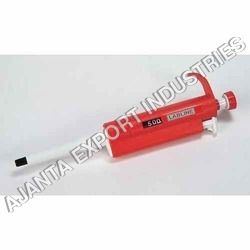
Precision and Versatility in Laboratory Liquid HandlingWith increment settings as fine as 0.1 L, this micropipette ensures high-precision dispensing for various laboratory applications. Its variable volume range caters to different experiment needs, making it a vital tool for research, clinical, and educational settings. The digital display and ergonomic design provide enhanced usability and consistent results.
Robust Materials for Reliability and ComfortConstructed from high-grade borosilicate glass, stainless steel, polypropylene, and TPE, the micropipette offers durability and chemical resistance. The lightweight and ergonomically shaped pistol grip reduce user fatigue during prolonged use. Its color-coded system allows quick identification, streamlining the workflow in multi-user environments.
Easy Sterilization and MaintenanceA fully autoclavable lower part supports effective sterilization at 121C, maintaining hygiene and preventing cross-contamination. The user-friendly design includes straightforward calibration and maintenance procedures, ensuring reliable performance and extending the instrument's lifespan.
FAQ's of Micropipette:
Q: How should the micropipette be sterilized for laboratory use?
A: The micropipette's lower part is fully autoclavable and should be sterilized at 121C. Ensure the removable lower section is disassembled as per the user manual, placed in an autoclave, and then reassembled after cooling to maintain both hygiene and device integrity.
Q: What types of liquids can this micropipette handle safely?
A: Thanks to its borosilicate glass and high-grade polypropylene construction, the micropipette is compatible with a wide range of aqueous and organic solutions commonly used in laboratory protocols, provided proper tips are used to prevent contamination or chemical incompatibility.
Q: When is calibration necessary for this micropipette?
A: Calibration is recommended periodically, typically every three to six months, or after extensive use, autoclaving, or exposure to harsh chemicals. Easy calibration features enable rapid adjustments to maintain precision and compliance with ISO 8655 standards.
Q: Where can I use this micropipette, and what applications is it suitable for?
A: Designed for laboratory use, this micropipette is suitable across research, academic, clinical, and industrial settings. Its variable volume and high precision make it ideal for molecular biology, analytical chemistry, microbiology, and general liquid handling tasks.
Q: What is the benefit of the ergonomic and lightweight design?
A: The ergonomic pistol grip shape and lightweight construction minimize strain during repetitive pipetting, enhancing comfort and accuracy. This design is beneficial for users engaged in long laboratory sessions, reducing the risk of repetitive strain injuries.
Q: How does the color coding and digital display system aid in laboratory workflow?
A: The color-coded system allows swift identification of different volume ranges, preventing selection errors, especially in multi-user labs. The digital volume display ensures precise setting and quick adjustments, streamlining processes and reducing downtime.






 English
 Spanish
 French
 German
 Italian
 Chinese (Simplified)
 Japanese
 Korean
 Arabic
 Portuguese


 Send Inquiry

