Product Description
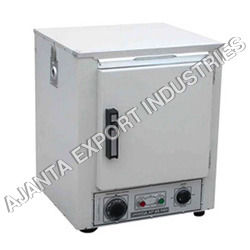
Laboratory Oven
Our company is engaged in offering a wide range of laboratory ovens (Hot Air Oven) that is widely used in variety of thermal processing. These also find application in general lab work component and stability testing, core hardening, drying glassware and sterilizing. Some of the features are:
Double walled outer mild steel & inner mild steel or stainless steel.
80/20 Ni heating elements
Temperature range : 5c above ambient to 300c 2c
230v ac 50 Hz mains supply
Digital temperature controller
Our range of laboratory oven is available in following given models:| Models | Chamber H x W x D (cms) | Watts | Shelves |
| AEI-20a | 30 x 30 x 30 | 750 | 1 |
| AEI-20b | 35 x 35 x 35 | 1000 | 2 |
| AEI-20c | 45 x 45 x 45 | 1500 | 2 |
| AEI-20d | 45 x 45 x 60 | 1750 | 2 |
| AEI-20e | 60 x 60 x 60 | 2000 | 3 |
| AEI-20f | 45 x 60 x 90 | 2200 | 3 |
| AEI-20g | 60 x 60 x 90 | 2500 | 3 |
Built with an SS 304 stainless steel inner chamber and CRCA powder-coated outer body, this laboratory oven combines durability with efficient heat distribution. The four-tray design accommodates multiple samples, supported by a sturdy chamber thickness of 1.5-2 mm. The inclusion of a digital LED controller and recorder ensures precise monitoring of temperature and sterilization cycles.
Enhanced Safety & User EaseThe oven is equipped with over-temperature protection and a door safety switch for secure operation. Convenient hinged double-walled doors with high-grade gaskets ensure consistent sealing, while inner and outer trolleys simplify loading and unloading of materials, maximizing laboratory productivity and user comfort.
Efficient Sterilization & Versatile ApplicationsDesigned for sterilization, drying, and laboratory use, this hot air oven delivers uniform heating (2C at 180C) via forced air convection. Adjustable temperature (up to 250C) and sterilization times (0-120 min) accommodate diverse laboratory processes, from glassware sterilization to critical drying requirements, making it essential equipment for research and diagnostics.
FAQ's of Laboratory Oven:
Q: How does the laboratory oven ensure uniform temperature distribution during operation?
A: Uniform temperature distribution is achieved through a motorized blower and forced convection system, ensuring all four stainless steel trays receive consistent heat. The high-quality insulation and chamber design help maintain steady conditions throughout the sterilization cycle.
Q: What safety features are incorporated in this laboratory oven?
A: The oven includes over-temperature protection, a door safety switch, and robust double-walled doors with high-grade gaskets. These features collectively guard against overheating and accidental exposure, providing secure operation and peace of mind for laboratory personnel.
Q: When should I use the adjustable sterilization timer and temperature settings?
A: You should adjust the sterilization timer (0-120 min) and temperature (ambient +10C to 250C) depending on your specific application, such as sterilizing glassware, drying samples, or processing chemicals. The flexibility allows for precise control based on material type and laboratory protocols.
Q: Where is the oven typically installed in a laboratory setting?
A: This oven is designed for floor mounting. Its robust build, including provided trolleys for easy material handling, makes it suitable for installation in research laboratories, quality control sections, or industrial labs requiring reliable and safe sterilization equipment.
Q: What are the main benefits of using this laboratory oven for sterilization?
A: The key benefits include accurate and programmable temperature control, rapid heating with efficient air circulation, and enhanced safety measures. These ensure reliable sterilization, improve laboratory workflow, and safeguard users during intensive operations.
Q: How can the oven's digital temperature controller and recorder assist in laboratory documentation?
A: The digital controller and recorder provide real-time monitoring of oven parameters, ensuring precise compliance with experimental protocols. This feature is invaluable for record keeping, validation, and quality assurance processes in accredited laboratories.







 English
 Spanish
 French
 German
 Italian
 Chinese (Simplified)
 Japanese
 Korean
 Arabic
 Portuguese



 Send Inquiry

