Product Description
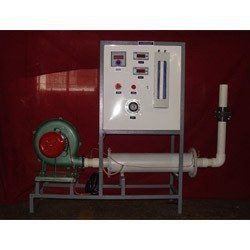
We are engaged in offering a wide array of Forced Convection Apparatus. The unit consists of a circular pipe, losing heat by forced convection to air, being forced through it. Constant heat flux is added to pipe by an electrical heater, provided with input control. Test pipe is connected to the delivery side of the blower along with the Orifice to measure flow of air through the pipe. Thus the students can calculate local and overall heat transfer coefficients in forced convection, at various airflow rates and various heat flux values.Specifications:- Test pipe- 32mm N B G.I. pipe, heated by band heater, out side
- Centrifugal blower to force air through test pipe with flow Control switch
- Variac 2A, capacity to control heater input
- An orifice meter with water manometer
- Voltmeter and ammeter to measure heater input
- Multichannel digital temperature indicator to measure various Temperatures
- A technical manual accompanies the unit
Services Required:- L Bench area of about 1. X 0.75m. At working height
- 230V, 15A, AC, supply with earthing connection
Precise Temperature Control and MonitoringEquipped with a microprocessor-based PID controller and a PT-100 RTD sensor, this apparatus guarantees precise regulation of the sterilizing temperature, ranging from room temperature up to 200C. The digital LED display provides clear readings of both temperature and processing time, ensuring high accuracy and easy monitoring for reliable experimental outcomes.
Build Quality and MobilityThe inner chamber is crafted with mirror-polished SS 304 stainless steel, complemented by a mild steel powder-coated exterior for enhanced durability and corrosion resistance. The apparatus features lockable castor wheels for effortless movement within the lab, and robust finishing ensures easy cleaning and longevity in demanding laboratory environments.
User-Friendly Design and Versatile UsageThe chamber is accessible through a hinged, insulated door with a secure locking mechanism, while high-temp resistant silicone rubber gaskets prevent heat leakage. Removable perforated steel trays accommodate up to eight samples per cycle, supporting a variety of research and testing applications. An intuitive interface and adjustable air velocity further enhance its adaptability and convenience.
FAQ's of Forced Convection Apparatus:
Q: How is heat distribution maintained uniformly within the Forced Convection Apparatus?
A: Uniform heat distribution is achieved through a multi-nozzle forced air system, dynamically balanced axial flow fan, and high-efficiency finned tubular air heater. These components ensure consistent air velocity and temperature, maintaining a uniformity of 2C throughout the chamber.
Q: What safety features does this apparatus offer during operation?
A: The apparatus includes a temperature cut-off mechanism, a pressure release valve, and a durable insulated door with secure locking to safeguard users and samples. Its high-density mineral wool insulation provides additional protection and thermal stability.
Q: Where can this forced convection equipment be utilized effectively?
A: This apparatus is ideal for laboratories in research institutions, universities, pharmaceuticals, and industrial quality control labs. It is especially suitable where precise sterilization, drying, and convection-based heating processes are required.
Q: What is the process for using this device for sample testing or sterilization?
A: Place up to eight samples on the removable perforated steel trays, set the desired temperature and time on the PID controller, and start the apparatus. Airflow and temperature are maintained automatically, and digital displays allow real-time monitoring and process logging until the operation completes.
Q: When should the chamber's pressure and temperature settings be adjusted?
A: Pressure and temperature should be set prior to the start of each cycle, in accordance with sample and test requirements. The apparatus supports adjustable settings from room temperature to 200C and 1.0 bar operating pressure, with safety interlocks for protection.
Q: What are the benefits of the stainless steel construction for laboratory use?
A: Stainless steel (SS 304/316) offers superior resistance to corrosion, maintains hygiene, and is easy to clean or sterilize. Its robust design ensures longevity and minimizes sample contamination risks in high-temperature environments.







 English
 Spanish
 French
 German
 Italian
 Chinese (Simplified)
 Japanese
 Korean
 Arabic
 Portuguese



 Send Inquiry

