Product Description
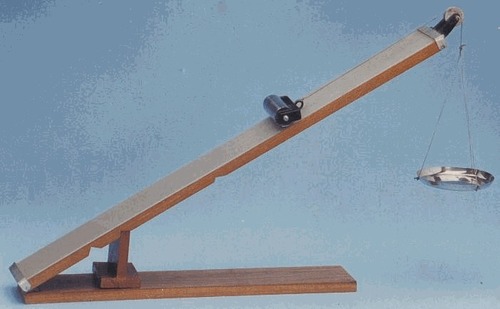
INCLINED PLANE, SIMPLE AND FRICTION BOARD
Inclined wood plane, 600 x 75 mm, hinged to base at one end carries a pulley at the other. A movable block enables variation of inclination of plane, a friction slide of size 100 x 65 mm which is reversible and has one side cut away for half of its area. Complete with metal roller 75 x 25 mm dia, with pan but without masses.
Explore Variable Friction and AngleThis apparatus lets users adjust the plane's angle from 0 to 45 degrees and swap between smooth and rough surfaces. These features provide a practical platform for studying how angle and surface type affect friction, motion, and mechanical advantage in real time, reinforcing physics concepts through interactive learning.
Sturdy and Reliable ConstructionConstructed from wood and steel, this board boasts a robust, polished finish and an anti-slip base for enhanced safety during demonstrations. The brass pulley ensures smooth, low-resistance motion, and the board's rectangular shape accommodates a wide variety of experimental setups in laboratory environments.
Designed for Educational ExcellenceTailored for secondary and higher education labs, this friction board comes equipped with all essential accessories required for classic experiments. Its clear scale graduations, adjustable control, and manual operation make it ideal for exploring fundamental principles of mechanics, helping students visualize and quantify physical phenomena.
FAQ's of INCLINED PLANE, SIMPLE AND FRICTION BOARD:
Q: How is the angle adjusted on the Inclined Plane Simple & Friction Board?
A: The device includes a mechanism allowing you to manually select any slant between 0 and 45 degrees. Angles are clearly marked on the board for accurate and repeatable setup, making it easy to demonstrate the relationship between angle and force.
Q: What experiments can be conducted with this equipment?
A: You can perform a wide range of physics experiments, such as investigating the effects of friction, mechanical advantage, and resolving forces on an incline. Both smooth and rough surface boards allow for comparative friction studies, while the included roller and weights provide further experimental flexibility.
Q: When and where should this apparatus be used?
A: This equipment is best suited for laboratory environments in schools, colleges, and universities. It is typically used during physics lessons or lab sessions focused on simple machines, mechanics, or the principles of friction.
Q: What is the process for changing the friction surfaces?
A: The board is supplied with interchangeable smooth and rough boards. Simply remove the current surface and replace it with the other to alter the frictional properties instantly, enabling a variety of experiments within one session.
Q: What are the main benefits of using this friction board?
A: The main benefits include visual and hands-on demonstration of force, friction, and mechanical concepts, adjustable angles for varied experiments, and durable construction for repeated educational use. It simplifies learning by making abstract principles tangible and easy to understand.
Q: How should this equipment be maintained?
A: Maintenance is straightforward-just wipe the board clean with a dry cloth after use. This helps preserve its smooth, polished surface and ensures longevity of the equipment.







 English
 Spanish
 French
 German
 Italian
 Chinese (Simplified)
 Japanese
 Korean
 Arabic
 Portuguese


 Send Inquiry

