Product Description
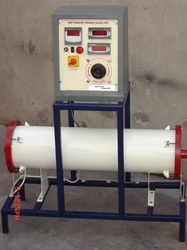
The setup is designed and fabricated to study lagging phenomenon in case of pipes. It consists of three concentric pipes of small thickness as compared to diameter and are arranged concentrically, and closed with the help of two discs. Two different insulating materials fill the annuli between the cylinders compactly. Temperature Sensors are fitted to measure the temperature of pipe walls for radial outward heat flow measurement. Inside the inner pipe, a Nichrome wire heater is placed axially. Heat input to the heater is given through a variac and measured by Digital Voltmeter and Digital Ammeter. By varying the heat-input rates, wide range of experiments can be performed
Experiments
- To estimate the actual rate of heat transfer through the composite cylinders from the measured interface temperature of the known value of thermal conductivity of the two insulating materials.
- To determine the effective thermal conductivity of the composite cylinders
- To determine the theoretical temperature profile within the composite cylinders
Utilities Required
- Electricity Supply: 1Phase, 220 V AC, 2 Amp.
- Table for set-up support
Advanced Laboratory Tool for Heat StudyThis apparatus is specifically constructed for the assessment of heat transfer in lagged pipes, making it indispensable for experimental setups in laboratories. Its stainless steel build offers remarkable resistance to corrosion while ensuring consistent performance across its operational temperature range.
Precise and Versatile PerformanceWith a wide temperature range of 20 to 150C and adaptable voltage input (110-220V), this setup suits various laboratory requirements. It delivers accurate results in heat conduction and insulation studies, making it a trusted tool for both instructional demonstrations and research investigations.
FAQ's of Heat Transfer Through Lagged Pipe:
Q: How is the Heat Transfer Through Lagged Pipe apparatus used in laboratories?
A: This equipment is used to experimentally study the heat transfer and insulation properties of lagged pipes. It allows students and researchers to measure temperature differences and calculate heat loss, providing real-world insight into thermal conductivity principles.
Q: What is the primary benefit of using stainless steel in the construction of this apparatus?
A: Stainless steel provides excellent durability, resistance to corrosion, and stability at varying temperatures, ensuring long-lasting performance and reliable experimental results even with repeated use.
Q: When should the Heat Transfer Through Lagged Pipe apparatus be used?
A: It is ideal for laboratory experiments focused on thermal studies, particularly when investigating conductivity, insulation effectiveness, or demonstrating fundamental principles of heat transfer to students.
Q: Where is this apparatus commonly applied?
A: The apparatus is widely used in educational laboratories, research centers, and industrial training institutes across India to supplement learning and research on thermal behavior in lagged pipes.
Q: What is the typical process of a heat transfer experiment using this apparatus?
A: A standard experiment involves heating the pipe, recording temperature gradients across both the lagged and unlagged sections, and analyzing the heat flow through the pipe insulation to better understand thermal losses and material efficiency.
Q: How does this equipment contribute to laboratory learning and research?
A: It enhances learning by providing hands-on experience with thermal concepts and validates theoretical knowledge through practical observation, enabling a deeper understanding of heat transfer mechanisms in real-world scenarios.







 English
 Spanish
 French
 German
 Italian
 Chinese (Simplified)
 Japanese
 Korean
 Arabic
 Portuguese


 Send Inquiry

