Product Description
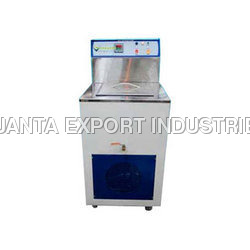
Low Temperature Cryostat Baths/Recirculators
Our company also offers low temperature cryostat baths that are of mild steel exterior finished with powder coating paint. Theses baths are made of S.S and have immersion type heaters for accuracy of temperature, with PUF insulation. We offer two types of baths i.e., Table Top and Floor Models.
| Model | Temp. Range | Capacity (Ltr.) | Chamber Dimension W x D x L (cms) | Bath Opening (cms) |
| Table top models |
| AEI-34a | 0º to 50ºC | 12 Ltr | 20 x 15 x 45 | 20 x 20 |
| AEI-34b | -20º to 50ºC | 12 Ltr | 20 x 15 x 45 | 20 x 20 |
| AEI-34c | -40º to 50ºC | 12 Ltr | 20 x 15 x 45 | 20 x 20 |
| Floor models |
| AEI-34d | 0º to 50ºC | 15 Ltr | 20 x 17 x 45 | 20 x 20 |
| AEI-34e | -20º to 50ºC | 15 Ltr | 20 x 17 x 45 | 20 x 20 |
| AEI-34f | -40º to 50ºC | 15 Ltr | 20 x 17 x 45 | 20 x 20 |
| AEI-34g | 0º to 50ºC | 25 Ltr | 25 x 20 x 52 | 25 x 25 |
| AEI-34h | -20º to 50ºC | 25 Ltr | 25 x 20 x 52 | 25 x 25 |
| AEI-34i | -40º to 50ºC | 25 Ltr | 25 x 20 x 52 | 25 x 25 |
Equipped with a microprocessor digital controller, this cryostat bath ensures precise regulation and stability of temperatures between -90C and +100C. The system enables LED/LCD display for easy monitoring, delivering heat uniformity to 0.1C across the bath chamber, making it highly reliable for critical laboratory experiments.
Robust and Eco-Conscious ConstructionConstructed with an inner SS304 stainless steel chamber and external powder-coated mild steel, these recirculators guarantee long-term corrosion resistance and durability. The use of non-CFC, eco-friendly refrigerant minimizes environmental impact, while polyurethane foam (PUF) insulation ensures optimal thermal efficiency.
Versatile Laboratory ApplicationsSuitable for a wide range of laboratory needs, these units can accommodate volumes from 5 to 50 litres depending on the model. Designed for processes requiring stable cooling or heating, they serve in research, quality control, and analytical testing, providing effective temperature regulation for sensitive experimental setups.
FAQ's of Low Temperature Cryostat Baths/Recirculators:
Q: How do Low Temperature Cryostat Baths/Recirculators maintain temperature stability?
A: These units utilize a microprocessor digital controller and an SS304 circulating loop, ensuring precise and uniform temperature maintenance between -90C and +100C. The high-quality insulation (PUF) and hermetically sealed compressor further enhance temperature stability, vital for laboratory applications.
Q: What materials are used in the construction of the cryostat baths, and what benefits do they offer?
A: The inner chamber is made of corrosion-resistant SS304 stainless steel, providing chemical durability and easy maintenance. The external housing is powder-coated mild steel for robust protection. Together, these materials ensure longevity and reliability under intensive laboratory use.
Q: When is it ideal to use these cryostat baths in laboratory settings?
A: These baths are ideal when processes require precise cooling or heating, such as in chemical testing, biological assays, materials science or calibration of temperature sensors. They can operate safely across a wide temperature range for diverse research and testing environments.
Q: Where can the cryostat baths be installed within a laboratory?
A: Design options include both tabletop/bench-top models. Depending on the model and capacity chosen-portable versions are also available-installation can be tailored to available workspace without the need for external trolleys or piping configurations.
Q: What safety features are incorporated in these cryostat baths?
A: For enhanced safety, these units provide low liquid level protection, over-temperature cutoff, and over-current protection, helping prevent accidents, equipment damage, or sample loss during critical experiments.
Q: How does the external circulation process work with these recirculators?
A: Optional accessories such as external circulation adapters and hose kits allow these units to circulate temperature-controlled fluids to external equipment or vessels, enabling versatile integration with broader laboratory systems.







 English
 Spanish
 French
 German
 Italian
 Chinese (Simplified)
 Japanese
 Korean
 Arabic
 Portuguese



 Send Inquiry

