Product Description
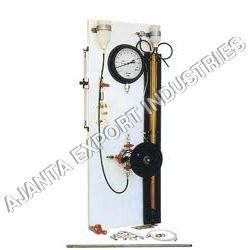
We put forth Gradient Ratio Test Apparatus that is widely appreciated for its longer life and durable make. This machine tests the ratio of hydraulic gradient through the geotextile plus 25.4 mm of the soil. It is relatively checked against the hydraulic gradient through the adjacent 50.8mm of the soil. This range measures accurate readings after 24 hours of flow.
The technical specifications are as follows:
Longer service life
Easy usage
High performance
Technical Specification:
| Cat. No. | Specimen dia | Compaction of Soil | Head of Water |
| AEI-704 | 100 mm | 10cm of dia x 11.2cm height | Upto 37.5cm |
The Gradient Ratio Test Apparatus is meticulously engineered for laboratories to determine soil's susceptibility to piping and its filtration ability. Its design adheres closely to IS: 2720 (Part 22) standards, guaranteeing trustworthy results. The three pressure cells-upper, center, and lower-enable the analysis of different soil gradients in a single set-up, providing laboratories with comprehensive data for informed decision-making in geotechnical studies.
Durable Construction and User-Friendly DesignManufactured from powder-coated mild steel, this apparatus ensures longevity and corrosion resistance. The easy screw couplings, along with high-precision acrylic manometers, simplify set-up and result collection. With accessories like rubber tubing and porous stones included, users can rely on a smooth and efficient testing experience, regardless of sample size or frequency of use.
FAQ's of Gradient Ratio Test Apparatus:
Q: How is the Gradient Ratio Test Apparatus used to determine soil filtration properties?
A: The apparatus functions by passing water through a soil sample contained within its three pressure cells. By analyzing the pressure differences and water flow across the upper, center, and lower gradients-monitored via the acrylic manometers-laboratories can determine the soil's filtration properties and susceptibility to piping.
Q: What are the main features of the Gradient Ratio Test Apparatus?
A: Key features include three 500 ml test flasks, high-precision acrylic manometers, three distinct pressure cells for multi-gradient testing, powder-coated mild steel construction, and user-friendly screw coupling connections. Models are available with either analog or digital displays.
Q: When should I use the Gradient Ratio Test Apparatus in my laboratory?
A: This apparatus should be employed when you need to assess the piping potential or filtration capacity of soil samples, especially when working on geotechnical investigations, filter materials design, or any application requiring compliance with IS: 2720 (Part 22).
Q: Where is this apparatus most commonly used?
A: It is widely used in soil testing laboratories, engineering research centers, and quality control labs of construction and civil engineering projects across India and internationally.
Q: What is the process involved in setting up and operating the Gradient Ratio Test Apparatus?
A: To operate, assemble the apparatus using the provided accessories, insert the soil sample, connect with rubber tubing, and fill the test flasks. Use the clamps and stoppers as required, set the desired pressure gradient, and monitor fluid levels on the manometers to analyze results.
Q: What are the main benefits of using this apparatus?
A: Benefits include precise measurement of soil filtration characteristics, compliance with the relevant IS standard, robust construction for long-term use, ease of operation, and suitability for a variety of sample sizes and testing requirements.
Q: How can I obtain replacement parts or accessories for the apparatus?
A: Replacement accessories such as rubber tubing, porous stones, clamps, and stoppers are available directly from the manufacturer, supplier, or authorized distributors and traders throughout India.







 English
 Spanish
 French
 German
 Italian
 Chinese (Simplified)
 Japanese
 Korean
 Arabic
 Portuguese


 Send Inquiry

