Product Description
FRICTION CALORIMETER UNIT
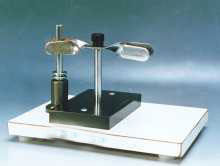
Comprises of copper calorimeter 60 x 6 mm with integral pulley of 20 mm dia. rotates in a boss, mounted on base and the friction brake consists of cork lined jaws on pillar, both mounted on base.
Precision Heat Measurement by FrictionEngineered for engineering laboratories, this friction calorimeter delivers reliable data on the heat produced by mechanical friction between surfaces. The advanced rotation mechanism and variable speed controller allow users to conduct both manual and continuous measurements. Its analog display provides clear readings of speed and temperature for accurate analysis, supporting critical experimental learning in tribology and thermodynamics.
Durable Construction and User-Friendly OperationManufactured from premium mild steel with powder coated or enamel paint, and fitted with stainless steel contact parts, the unit is built for long-term durability. Anti-skid feet stabilize the device during experiments, while shielded rotating components and overload protection enhance operational safety. The sample holder's precision chuck ensures secure, repeatable placement of test samples, facilitating smooth and hassle-free laboratory work.
Versatile Applications in Engineering EducationIdeal for friction and heat measurement experiments, this calorimeter unit is widely used in academic and research laboratories across engineering institutes. It comes with a calibration certificate upon request, ensuring measurements are traceable and accurate. Its easy-to-use controls, low noise level, and high sensitivity make it a preferred choice for hands-on learning, experimentation, and demonstration of core engineering concepts.
FAQ's of FRICTION CALORIMETER UNIT:
Q: How does the Friction Calorimeter Unit measure heat generated by friction?
A: The unit measures the rise in temperature due to friction between a rotating shaft and the test sample fixture. Borosilicate thermometers precisely record temperature changes, allowing calculation of heat produced by friction during experiments.
Q: What types of samples can be tested with this device?
A: The precision chuck accommodates pins or cylinders, making the unit suitable for a variety of engineering materials and shapes used in friction studies or comparative material analysis.
Q: When should calibration be performed on this calorimeter unit?
A: Calibration is recommended before the first use and at regular intervals based on your laboratory's QA protocols. A calibration certificate is provided upon request to ensure traceable, accurate results.
Q: Where can this friction calorimeter be used?
A: It is designed for use in laboratory environments, especially engineering educational and research institutes. Its bench-top design with anti-skid feet ensures stable placement on standard laboratory tables.
Q: What is the process for operating the friction calorimeter?
A: To operate, secure the test sample in the chuck, set the desired speed (up to 2000 RPM) using the variable controller, and monitor temperature rise with the included thermometers. Both manual and continuous operation modes are available, and results are read via analog dials.
Q: How does this unit ensure safety during operation?
A: The device is equipped with overload protection for the motor and shielded rotating parts to minimize the risk of injury or equipment damage, keeping the user safe throughout experiments.
Q: What are the main benefits of using this friction calorimeter unit in labs?
A: Users benefit from high measurement sensitivity (0.1C accuracy), low operational noise (<60 dB), low maintenance, and a robust construction that supports repeated educational and research experiments.







 English
 Spanish
 French
 German
 Italian
 Chinese (Simplified)
 Japanese
 Korean
 Arabic
 Portuguese


 Send Inquiry

