Product Description
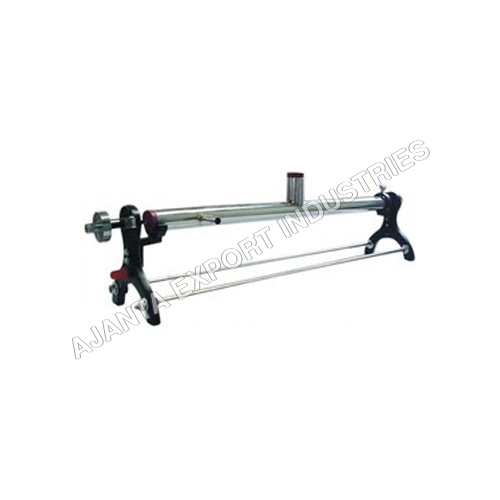
Consisting of a metal rod, 500mm in length and 4.5mm diameter, enclosed in a well lagged, nickle plated brass tube with three tubules for steam, inlet, outlet and thermometer. The metal rod to be studied is supported in the steam jacket by detachable conical cups situated at each end of the tube. The apparatus is carried on a heavy gauge channel base, at one end of which is an adjusting screw. At the opposite end is a micro meter screw reading to 0.01mm for measuring the expansion. Supplied complete with copper, brass & iron rods but without thermometer. Precision in Thermal Expansion MeasurementsEquipped with a Vernier scale reading mechanism and interchangeable metal rods, this apparatus delivers highly accurate results when measuring the expansion of metals under heat. Its bench-top, manual observation design makes it suitable for detailed lab investigations, with a special heating arrangement ensuring uniform thermal exposure.
Durable Construction and Flexible AccessoriesThe apparatus is built with sturdy, powder-coated mild steel and a stainless steel frame. Brass clamps securely hold sample rods, while the assortment of metals-brass, aluminum, and iron-allows for comprehensive comparative studies. Every unit arrives with an instruction manual and robust packaging for safe transport.
Wide Temperature Range and Safe OperationThe borosilicate thermometer offers measurements from -10C to 110C, supporting varied experimental requirements. With an electrical heating coil and efficient temperature resistance (up to 150C), the device offers both reliability and safety, ideal for physics education and research settings.
FAQ's of Linear Expansion Apparatus:
Q: How does the Linear Expansion Apparatus work in a laboratory setting?
A: The apparatus functions by securely clamping a metal rod, then heating it using an integrated electrical heating coil. As the temperature rises, the rod expands, and the precise change in length is measured using the Vernier scale and pointer, allowing for accurate experimental determination of the material's linear thermal expansion coefficient.
Q: What types of measurements can be conducted with this apparatus?
A: It is mainly used to measure the linear expansion of metals, typically brass, aluminum, and iron rods. Using the vernier scale, readings can be taken before and after heating to calculate the change in length, helping determine the coefficient of linear expansion for each material.
Q: When should the apparatus be used during educational experiments?
A: This instrument is ideal for use during physics lessons on thermal expansion. It is especially effective when students need hands-on experience with measurement techniques and the physical properties of metals under heat.
Q: Where is the Linear Expansion Apparatus most commonly employed?
A: The device is primarily used in educational laboratory environments, such as schools, colleges, and universities, where precise measurement and demonstration of thermal expansion phenomena are essential to curriculum and research.
Q: What is the process for conducting an experiment with this equipment?
A: Begin by placing a metal rod in the sample holder and secure it using the brass clamps. Note the initial scale reading, then activate the electrical heating coil. Monitor the temperature rise with the thermometer, take the final reading after expansion, and calculate the coefficient based on observed changes.
Q: How does manual observation benefit users of this apparatus?
A: Manual observation with the Vernier scale and pointer provides students and researchers with hands-on experience in precise measurement, data collection, and understanding of fundamental thermal principles, enhancing conceptual learning and procedural proficiency.
Q: What are the main benefits of using this linear expansion apparatus in a laboratory?
A: Key benefits include accurate measurement (0.01 mm), sturdy construction, interchangeable rods for various material studies, safe operation at laboratory voltages, and export-quality packaging, making it a reliable choice for educational and research purposes.






 English
 Spanish
 French
 German
 Italian
 Chinese (Simplified)
 Japanese
 Korean
 Arabic
 Portuguese


 Send Inquiry

