Product Description
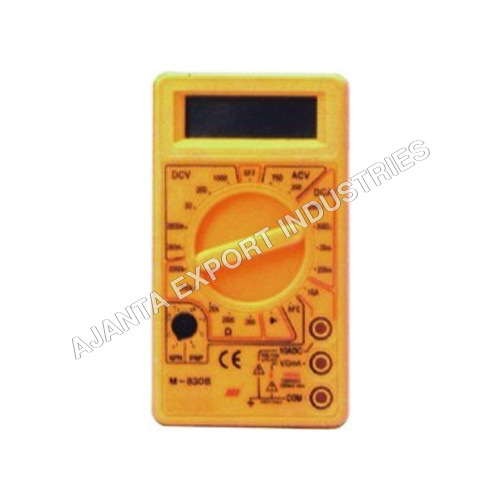
Digital-Multimeter-Model
| D.C. Voltage : | 200mV-1000V +0.5% +2 digits |
| A.C. Voltage : | 200V-750V +1.2% +10 digits |
| D.C. Current : | 200mA-10A +1% + digits |
| Resistance : | 200Ohms-2000kOhms+0.8%+2 digits |
| Max. Display : | 1999 |
| Display Size : | 16x48mm., 3, digits LCD |
| Range : | Manual |
| Transistor Test : | Yes Standard |
| Accessories : | Battery, Testing Probes with Instruction Manual, in case, CE Marked |
Advanced Measurement CapabilitiesThis model lets you measure voltage, current, resistance, and also perform diode, transistor, and continuity tests. It supports applications from simple battery testing to complex electronic troubleshooting, making it a reliable choice for laboratories, educational institutions, and fieldwork.
Robust Design for Convenience and SafetyMade from sturdy ABS plastic and weighing between 50-150 grams, the multimeter fits comfortably in hand for extended use. Its built-in safety fuse for the 10A range, CAT II 600V category, and overload protection features safeguard both the device and user during high-stress applications.
User-Friendly FeaturesThe device sports a rotary switch for easy mode selection, a backlit LCD display for clear data visibility, and an audible beeper for continuity checks. The data hold function allows you to freeze readings, while low battery indication ensures uninterrupted operation. These enhancements simplify daily measurements.
FAQ's of Digital-Multimeter-Model:
Q: How do I use the digital multimeter to measure current and voltage?
A: To measure current or voltage, set the rotary switch to the appropriate mode (DC or AC) for your intended test. Connect the probes according to the circuit, ensuring you do not exceed the specified maximums (DC 10A / AC 10A for current, DC 1000V / AC 750V for voltage). The backlit LCD will display the readings clearly.
Q: What types of electronic components can this multimeter test?
A: This model is equipped for testing a wide range of components, including transistors (with hFE socket), diodes, resistors, and continuity of connections. It also supports standard measurements for current, voltage, and resistance, covering most electrical diagnostic tasks.
Q: When should the fused protection feature be considered?
A: Always ensure the fused protection is intact before measuring high currents up to 10A. The internal fuse safeguards the meter and user against overload. If there is no reading or a sudden shutdown during current measurement, check and replace the fuse as needed.
Q: Where can this digital multimeter be used?
A: The device is suited for laboratory, educational, and general electrical testing. Its CAT II 600V safety rating makes it ideal for indoor environments such as workshops, laboratories, and electronics troubleshooting stations in India.
Q: What is the benefit of the data hold and backlight functions?
A: The data hold feature lets you freeze the measured value on the display for reference, eliminating the need to memorize or note it quickly. The backlight ensures the screen remains readable in dimly lit environments, improving efficiency and reducing errors.
Q: How do I test transistors and diodes with this instrument?
A: Insert the transistor into the dedicated hFE socket for automatic gain (hFE) readings. For diodes, switch to the diode test mode and connect the probes to the diode terminals- the display will indicate the forward voltage or if the component is faulty.
Q: What maintenance steps are recommended for optimal performance?
A: To maintain accuracy, keep the probes and terminals clean, periodically check the battery level (replace with a 9V battery as needed), and ensure the fuse is functional. Store the multimeter away from moisture and extreme temperatures, ideally within its operating range of 0C to 40C.







 English
 Spanish
 French
 German
 Italian
 Chinese (Simplified)
 Japanese
 Korean
 Arabic
 Portuguese


 Send Inquiry

