Product Description
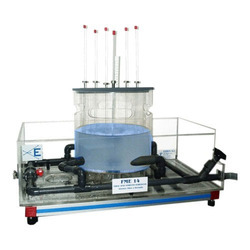
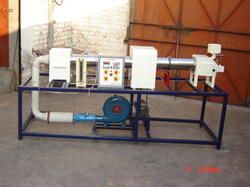
Forced Vortex Flow is an example of rotational flow and can be generated by rotating a cylinder containing a fluid about its axis or by rotating a paddle in a large volume of fluid. Under steady conditions, each particle will move with the same angular velocity and there will not be any relative motion between fluid particles. Streamlines for such a flow will be concentric circles and the total energy is constant along a streamline but varies from one streamline to another.Scope Of Experimentations:- Fill the cylinder with water to about one half of its height
- Rotate the cylinder with constant and reasonably fast speed
- The free surface of the water takes the form of a parabolic profile
- Measure the speed of rotation
- When conditions become steady, take the surface profile readings by traversing the Pitot-static tube, immersed just beneath the water surface along a radial line The surface elevation at r0 is taken as the datum for all these readings
- Now for the second run, speed from motor has been changed and again at steady state, take the surface profile readings
Utilities Required:- Power supply: Single Phase, 220 volts, 50 Hz, 5 Amp with earth
- Water Supply
- Drain
Technical Details:- Do not run the pump at low voltage i.e. less than 180 Volts
- Always keep apparatus free from dust
- To prevent clogging of moving parts, rum pump at least once in a fortnight
- Frequently Grease/Oil the rotating parts, once in three months
- Always Use Clean Water
- If the Apparatus is not in use for more than one month, drain the apparatus completely, and fill pump with cutting oil
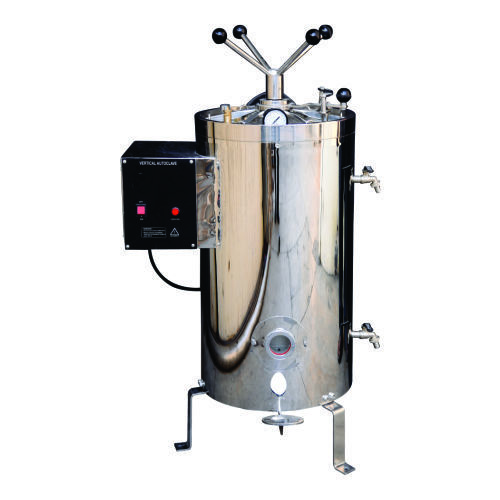
Advanced Microprocessor-based ControlEquipped with a user-friendly touch screen display, this system allows for easy configuration, monitoring, and management of sterilization cycles. The microprocessor-based controller ensures precise regulation of temperature, pressure, and timing, while the PLC with paperless recorder logs all crucial parameters for traceability and compliance.
Comprehensive Safety FeaturesSafety is paramount with built-in mechanisms such as automatic over-temperature cut-off, emergency stop switch, and pneumatic actuated valves. The audio-visual alarm system instantly notifies users about cycle completion or any detected faults, minimizing operational risks and enhancing overall laboratory safety.
Robust Construction and Hygienic DesignManufactured with corrosion-resistant SS 316L inner chambers and SS 304 trolleys, this system is built to withstand demanding laboratory environments. The mirror-polished interior and matt-finished exterior, plus fully welded SS 316L piping and superior insulation, ensure longevity, cleanliness, and efficient thermal performance.
FAQ's of Forced Vortex Flow:
Q: How does the forced vortex flow system ensure effective sterilization?
A: The system utilizes a rotary spray mode with atomized SS 316L nozzles to create a uniform vortex flow inside the chamber. This, combined with precise temperature maintenance (1C throughout the chamber) and a minimum sterilizing temperature of 121C, ensures even heat distribution and thorough sterilization of laboratory materials.
Q: What safety features are included with this control system?
A: The unit is equipped with multiple safety mechanisms, such as an automatic over-temperature cut-off to prevent overheating, a pressure relief valve, an emergency stop switch, pneumatic actuated valves, and an audio-visual alarm system to alert operators of cycle completion or faults.
Q: When is the audio-visual alarm system activated?
A: The audio-visual alarm is automatically triggered at the end of each sterilization cycle and whenever the system detects a fault or abnormal operation, ensuring users are promptly aware of cycle status or any issues that require attention.
Q: Where can this forced vortex flow sterilizer be installed?
A: This sterilizer is designed for laboratory environments and is suitable for installation in research labs, pharmaceutical manufacturing facilities, hospitals, and any location requiring GMP-compliant sterilization solutions. Its robust design supports both Indian and international voltage standards.
Q: What benefits does the double door, horizontal sliding design offer?
A: The double door, horizontal sliding mechanism provides enhanced biosecurity by enabling separate sterile and unsterile areas, minimizing the risk of cross-contamination and supporting efficient workflow within laboratory settings.
Q: How is the system's performance documented and validated?
A: The system provides full documentation including Installation Qualification (IQ), Operational Qualification (OQ), Performance Qualification (PQ), and Design Qualification (DQ) as per GMP standards. Additionally, a validation port is included for thermocouple and biological indicator placement, ensuring complete cycle validation.







 English
 Spanish
 French
 German
 Italian
 Chinese (Simplified)
 Japanese
 Korean
 Arabic
 Portuguese


 Send Inquiry

