Product Description
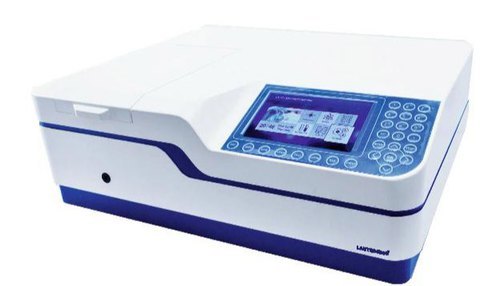
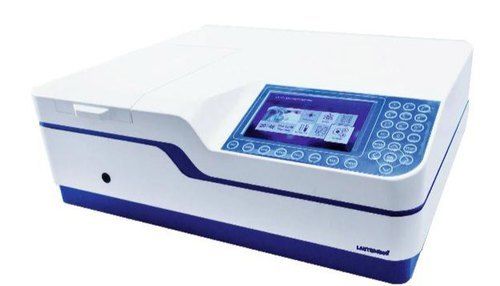
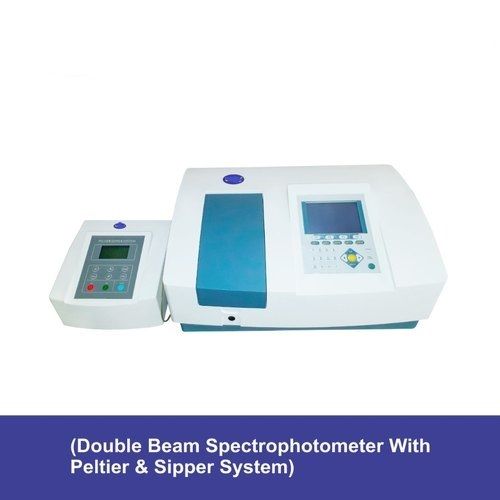
Variable Double Beam Spectro photo meter Device offered comes with wavelength range of 190-1100 mm (1200 Lines/mm grating) as well as Basic/Quantitative/Wavelength Scan/DNA Protein Test/Kinetics operational modes. For efficient performance, the system can deliver Fast / Medium / Slow scanning support as well as wavelength accuracy of+0.1 mm, bandwidth of 0.5, 1,2,4,5 and wavelength reproducibility of 0.1 mm.Some of the other standard features of this system include photo metric repeatability of + 0.2 % T, baseline flatness of + 0.001 A, USB based data output port and parallel printer port among others.
Details
| Model Number/Name | Aei-Db-RT01 |
| Brand | AjantaExports |
| Noise | +0.001A |
| Stray Light | 0.05% T @ 220nm, 360 nm) |
| Data Output Port | USB |
| Baseline Flatness | + 0.001 A |
| Photometric Display Range | 0-200 % T, -0.3 - 3.0 A, 0-9999 C |
| Wavelength Reproducibility | 0.1 nm |
| Bandwidth | 0.5, 1,2,4,5 |
| Detector | Silicon Photodiode |
| Dimensions(L x W x H) | 630 x 430 x 206 mm |
| Display | Graphic LCD (320 x 240 Dots) |
| Lamps | Deuterium Lamp & Tungsten Halogen Lamp |
| Net Weight | 26 Kg |
| Photometric Accuracy | + 0.3 % T |
| Photometric Repeatability | + 0.2 % T |
| Printer Port | Parallel Port |
| Scanning Speed | Fast / Medium / Slow |
| Stability | 0.001A/h @ 500 nm |
| Wavelength Range | 190-1100 nm (1200 Lines/mm grating) |
Reliable and Accurate MeasurementEngineered for high photometric and wavelength accuracy, this spectrophotometer supports applications requiring stringent analytical precision. The built-in automatic wavelength setting and baseline correction ensure consistent, dependable readings suitable for diverse laboratory environments.
Versatile ApplicationsSuited to pharmaceutical, chemical, water testing, research, and educational laboratories, this double beam instrument facilitates both qualitative and quantitative analysis. Its compatibility with quartz cuvettes and multiple cell holder options caters to a wide array of sample requirements.
Effortless Operation and ConnectivityFeaturing a digital microprocessor and large LCD display, the unit offers user-friendly controls for scan speed and settings. Built-in RS232C/USB interfaces allow seamless data transfer and reporting, supported by included Windows-based PC software for streamlined workflow.
FAQ's of Double beam uv Visible Spectrophotometer:
Q: How does the double beam design enhance measurement accuracy in this spectrophotometer?
A: The double beam design minimizes measurement errors caused by fluctuations in the light source and environmental conditions by simultaneously comparing sample and reference channels, improving photometric precision and reliability.
Q: What steps are involved in operating the spectrophotometer for routine analysis?
A: Operation begins by powering on the instrument, performing baseline correction, placing the sample in a compatible quartz cuvette, and selecting the appropriate wavelength parameters. The digital microprocessor controls and large LCD display simplify execution, while data can be saved or printed via USB or printer.
Q: When should I use the included Windows-based PC software with this device?
A: The included software should be used when advanced data analysis, storage, or remote control is needed. It is especially beneficial for complex experiments, data archiving, and report generation in research or quality control settings.
Q: Where can this spectrophotometer be used most effectively?
A: It is ideal for laboratory use in fields such as research, pharmaceuticals, chemical analysis, water testing, and academic settings, where high accuracy and versatile sample handling are required.
Q: What are the benefits of the automatic wavelength setting feature?
A: Automatic wavelength setting reduces user error, streamlines the setup process, and ensures accurate measurements by automatically adjusting to the desired testing wavelength, saving time and enhancing reproducibility.
Q: How does baseline correction work, and why is it important?
A: Baseline correction compensates for absorbance irregularities in the optical path or cuvette, ensuring measurements reflect only the sample's absorbance. This function is crucial for achieving accurate and reliable results, particularly in quantitative studies.







 English
 Spanish
 French
 German
 Italian
 Chinese (Simplified)
 Japanese
 Korean
 Arabic
 Portuguese



 Send Inquiry

