Product Description
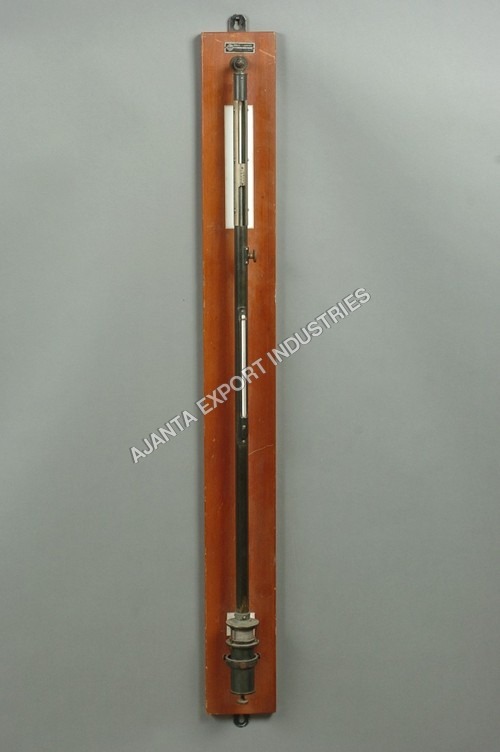
For school/college laboratories. Nominal 6 mm bore glass tube. With engine divided dual scales 675 to 820 x 1 mm Hg and 26.5 to 32.5 x 0.05 inch Hg. Verniers reading 0.05 mm and 0.002 inch. Mounted on polished wooden board for wall mounting. Supplied without mercury but with instructions for fillingSPARE S
(A)
| Standard Model 8 mm Borosil glass tube |
(B) | Deluxe Model 10 mm Borosil glass tube |
| (C) | Leather Bag |
High-Precision Atmospheric Pressure MeasurementThe Fortins Barometer offers accurate measurement of atmospheric pressure thanks to its vernier scale with 1 mmHg graduations. Its well-engineered manual adjustment system and mercury column deliver clear, repeatable results vital for laboratory research, meteorological studies, and educational use.
Robust, Elegant ConstructionMade with high-quality materials-transparent borosilicate glass, polished brass, and varnished wood-this classic Fortin device combines longevity with visual appeal. Its solid build and clear graduated scale provide reliable operation and easy viewing, making it ideal for frequent, demonstration-driven use.
Manual Operation-No Power RequiredThe Barometer Fortins operates completely mechanically, removing dependency on electrical power. The adjustable screw control allows manual fine-tuning for zero calibration, and the open liquid measurement ensures a hands-on learning experience in understanding atmospheric pressure dynamics.
FAQ's of BAROMETER FORTINS:
Q: How do I properly install and use the Fortins Barometer in a laboratory setting?
A: The Fortins Barometer can be either wall-mounted or used free-standing. Ensure it is placed in a stable, vibration-free environment at ambient laboratory temperature. Fill the transparent borosilicate tube with mercury as per safety guidelines, adjust the mercury level using the screw, and use the vernier scale to take precise readings.
Q: What safety precautions should I take when handling the mercury in the barometer?
A: Mercury is hazardous. Always handle the barometer over a spill tray, use gloves and eye protection, and ensure the area is well-ventilated. Dispose of mercury according to local regulatory safety guidelines, and refer to IS/ISO compliance instructions for mercury handling.
Q: When should the zero adjustment screw be used, and how does it affect measurements?
A: Use the zero adjustment screw before taking a reading to set the mercury column's base to the correct reference point. This ensures measurement accuracy by calibrating for any changes in mercury level, glass position, or ambient conditions.
Q: Where is this barometer typically used and what are its primary applications?
A: The Fortins Barometer is used mainly in laboratories, meteorological stations, and educational institutions across India and globally. Its applications include measuring atmospheric pressure for weather analysis, scientific experiments, and educational demonstrations.
Q: What process should I follow for accurate atmospheric pressure readings?
A: First, carefully calibrate the device with the zero adjustment screw. Next, align your eye with the vernier scale to avoid parallax error, then read the mercury column's height in mmHg divisions. Repeat the process each time before measurements for best accuracy.
Q: What are the key benefits of using the Fortins Barometer compared to modern digital equivalents?
A: The Fortins Barometer provides a hands-on, manual method of measuring atmospheric pressure, which is ideal for teaching and demonstration. Its mechanical operation means no power is required, and the classic design ensures long-term durability and accuracy with minimal maintenance.







 English
 Spanish
 French
 German
 Italian
 Chinese (Simplified)
 Japanese
 Korean
 Arabic
 Portuguese


 Send Inquiry

