Product Description
AUTOCLAVE
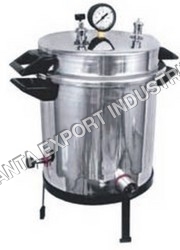
Suitable for general laboratory use and sterilization. Stainless steel or aluminum vertical body. Domed cover can be sealed by joint-less gasket which is clamped to the vessel by wing nuts by hinged bolts which engage slotted lugs on rim of the cover. Provided with dial pressure gauge. Spring loaded safety valve has threaded cp for pressure adjustments. Supplied complete with plug & cord and is suitable to work on 2 20V AC 50Hz single phase.
| Specification :- | AUTOCLAVE |
| Size : | a) 300x300 mm [Seamless]
b) 300x375 mm [Jointed]
c) 300x500 mm [Jointed] |
| Pressure range : | 15 psi to 18 psi |
| Make : | Ajanta |
| | |
Comprehensive Sterilization ControlThe autoclave's fully automatic microprocessor ensures precise sterilization cycles with real-time monitoring via a digital LCD touchscreen. Customizable settings allow users to adjust temperature and time, making it ideal for diverse applications in laboratories, hospitals, and pharmaceutical production. Enhanced digital controls not only simplify operation but also facilitate data recording for temperature, pressure, and sterilization time.
Premium Construction for Long-Term UseManufactured with polished SS304 on the outside and SS316 on critical internal components, this autoclave combines durability with efficient sterilization. The robust floor-mounted design, complemented by silicone gaskets and premium insulation, ensures user safety and optimal performance even in demanding environments. Maintenance is straightforward thanks to removable and perforated trays.
Advanced Safety and Efficiency FeaturesSafety is prioritized with automatic pressure locks, over-temperature cutoff, and high-integrity chamber construction. The unit consumes only 8 kW of power per cycle and operates efficiently with minimum water consumption (60-80 L/cycle), making it environmentally responsible as well. Its adjustable spraying mode and multi-directional steam circulation guarantee thorough sterilization every cycle.
FAQ's of AUTOCLAVE:
Q: How does the microprocessor control system improve the autoclave's sterilization process?
A: The microprocessor-based control system offers precise management of temperature, pressure, and timing for each sterilization cycle. It allows operators to customize and monitor each parameter via the digital LCD touchscreen, ensuring consistent and reliable sterilization results suitable for laboratory, hospital, or pharmaceutical applications.
Q: What safety features are included in this autoclave model?
A: Key safety features include an automatic pressure lock, over-temperature cutoff, and automatic safety and steam valves. The system also uses a durable silicone gasket resistant to high temperatures, ensuring safety during operation.
Q: Where can this autoclave be installed and what are its ideal applications?
A: This floor-mounted autoclave is designed for use in hospitals, pharmaceutical facilities, and laboratories. Its robust construction and ample chamber size make it suitable for sterilizing medical instruments, laboratory equipment, and pharmaceutical items.
Q: What is the process for sterilizing instruments in this autoclave?
A: Instruments are placed on removable, perforated trays within the inner stainless steel trolley. After selecting the appropriate cycle using the digital touchscreen, the autoclave automatically controls steam injection, temperature, and pressure, ensuring multi-directional spraying and thorough sterilization. Sterilization parameters can be recorded for traceability.
Q: How does the autoclave ensure energy efficiency and eco-friendly operation?
A: With a power consumption of only 8 kW per cycle and water usage between 60-80 liters, the autoclave offers efficient resource use. High-quality insulation minimizes heat loss, while the advanced control system optimizes each cycle for reduced energy waste.
Q: What are the main benefits of the SS316 piping and robust insulation?
A: SS316 piping and 50 mm glass wool insulation enhance the autoclave's resistance to high temperatures and corrosion, ensuring uniform heat distribution, energy savings, and long equipment lifespan, all essential for demanding sterilization tasks.







 English
 Spanish
 French
 German
 Italian
 Chinese (Simplified)
 Japanese
 Korean
 Arabic
 Portuguese


 Send Inquiry

