Product Description
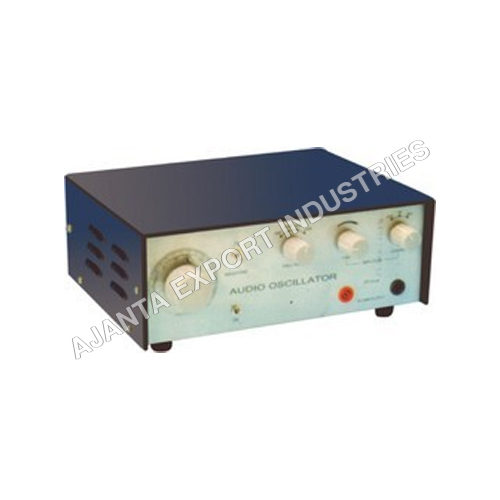
| Frequency Range : | 20 Hz to 50 KHz in four switched range plus a fine control Accuracy + 5%. |
| Waves : | Sine & Square |
| Amplitude : | Continuously variable from 0-8 Vpp. max. |
| Power : | Output upto 1 W. |
| Operates on : | 220V A.C. 50 Hz |
Reliable Frequency GenerationThis audio oscillator covers a typical output frequency range from 20 Hz up to 200 kHz, accommodating a wide range of laboratory and educational applications. The device features both sine and square wave outputs, making it suitable for a variety of audio circuit tests and experiments. Stable, low-impedance signal output ensures compatibility with standard laboratory equipment.
User-Friendly OperationSelecting your desired frequency is straightforward thanks to the 6-range rotary switch and fine control adjustment. The analog meter display provides clear visual feedback, while the durable, powder-coated metal enclosure ensures lasting protection for intensive laboratory usage. Lightweight and portable, this equipment is designed for easy transport and handling.
Safe and Durable ConstructionEquipped with fuse protection, this audio oscillator prioritizes user and equipment safety. The enclosure is made of aluminium with a textured paint finish, providing robust durability. Its compact, rectangular shape allows it to fit conveniently on lab benches without occupying excessive space. The device operates reliably on a standard, regulated AC mains supply.
FAQ's of Audio Oscillator:
Q: How do I select the desired output frequency on this audio oscillator?
A: Frequency selection is performed using the 6-range rotary switch for coarse adjustment, along with a fine control knob for precision tuning within each range. The selected frequency is indicated on the analog meter display, helping you achieve accurate results.
Q: What applications is this audio oscillator best suited for?
A: This oscillator is ideal for laboratory work, educational demonstrations, and audio circuit testing. Its stable signal and dual waveform outputs support a broad array of experiments and measurements in electronic and audio labs.
Q: When should I use the sine wave versus the square wave output?
A: Sine wave output is commonly used for testing frequency response, distortion, and linearity in audio circuits, while square wave output is useful for analyzing switching characteristics and transient response in electronic components and systems.
Q: Where can this oscillator be conveniently installed or used?
A: Thanks to its compact and sturdy design, the audio oscillator can be easily used on laboratory benches, classroom desks, or testing stations. Its portable weight and durable enclosure make it suitable for both permanent setups and mobile applications.
Q: What safety features are integrated into the oscillator?
A: Fuse protection is provided to guard against electrical overloads, ensuring safety for both users and the instrument. The enclosure's aluminium construction and powder-coated finish also protect the internal components from damage.
Q: How does the output impedance affect usage in laboratory experiments?
A: The output impedance of approximately 600 Ohms is designed to match standard audio and test equipment, ensuring minimal signal distortion and accurate transmission during circuit testing and measurement tasks.
Q: What are the main benefits of using this audio oscillator in a laboratory setting?
A: Users benefit from accurate frequency generation, stable long-term performance, ease of adjustment, and reliable safety features. The device's portability, clear analog display, and robust construction further enhance its suitability for laboratory, educational, and technical purposes.







 English
 Spanish
 French
 German
 Italian
 Chinese (Simplified)
 Japanese
 Korean
 Arabic
 Portuguese


 Send Inquiry

