Product Description
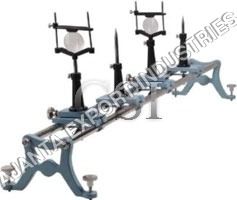
NEW-TYPE MEASURING INSTRUMENT FOR MOMENT OF INERTIA
| Description:
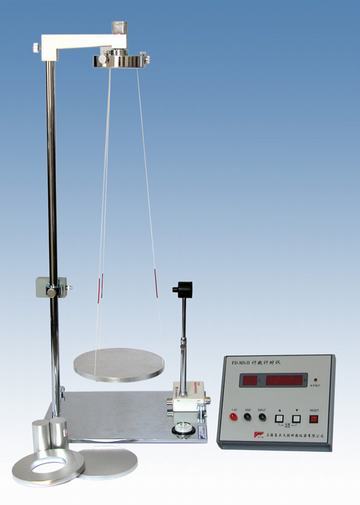
The instrument uses three-line pendulum to measure moment of inertia of objects and verify parallel-axis theorem. It uses laser photoelectric sensor to measure vibrant period accurately
Details: | Length of pendulum line: | <500 mm | | Time precision: | 0.001 s. | |
Innovative Torsional Oscillation TechnologyThis instrument bases its measurement on the torsional oscillation principle, allowing accurate determination of the moment of inertia for various objects. The manual/rotary control ensures users have full command over the process, while the analog dial provides clear, precise readings.
Engineered for Safety and DurabilityDesigned with a powder-coated finish and an anti-corrosive body, this instrument withstands rigorous laboratory conditions. The anti-skid rubber feet and temperature resistance up to 60C further enhance its safety and longevity, making it a reliable choice for repeated educational or research use.
User-Friendly Assembly and CalibrationAssembling and operating the device is straightforward, thanks to its compact, bench-mounted design and easy-to-follow instructions. Each unit comes with a calibration certificate, ensuring immediate and accurate start-up for all lab applications.
FAQ's of NEW-TYPE MEASURING INSTRUMENT FOR MOMENT OF INERTIA:
Q: How is the instrument installed and set up for use?
A: The instrument is designed to be bench-mounted and features anti-skid rubber feet for stability. Assembly is straightforward, with clear instructions allowing users to quickly set it up in any laboratory environment without the need for specialized tools.
Q: What measurement principle does this instrument utilize?
A: It operates on the torsional oscillation principle, enabling users to measure the moment of inertia by observing the oscillation period of objects mounted on the device.
Q: When should calibration be performed on this device?
A: Each unit is delivered with a calibration certificate, ensuring accuracy right out of the box. Routine recalibration is advised annually or following any disassembly or significant movement to maintain measurement precision.
Q: Where is this moment of inertia instrument most suitable for use?
A: This device is ideal for physics laboratories, engineering colleges, R&D centers, and other educational or research institutions focused on mechanical properties and dynamics.
Q: What is the main process for measuring the moment of inertia?
A: Users mount the object on the instrument, adjust weights as necessary, and initiate rotation using manual or rotary controls. The device's analog dial displays measurement results, which are based on the observed torsional oscillations.
Q: How easy is it to operate and maintain the equipment?
A: Designed for user-friendliness, the instrument is easy to assemble, operate, and maintain. Its robust, anti-corrosive construction reduces maintenance needs, and in-built features simplify regular upkeep.
Q: What are the benefits of using this instrument in an educational setting?
A: It provides students and researchers with hands-on experience in measuring physical properties with high precision. The device's accuracy, safety features, and ease of use enhance learning and experimental outcomes in physics and engineering programs.







 English
 Spanish
 French
 German
 Italian
 Chinese (Simplified)
 Japanese
 Korean
 Arabic
 Portuguese


 Send Inquiry

