Product Description
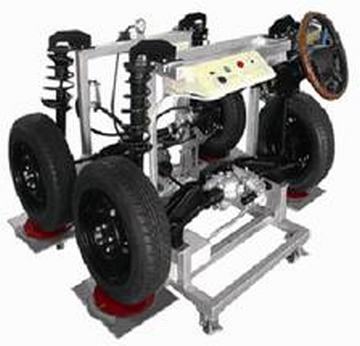
4-WHEEL STEERING SYSTEM EXPERIMENTAL PLATFORM
Description:
Teaching Function:
It applies to study theory and practice on 4-wheel steering system for all kinds of schools and training institutions.
Standard Configuration:
Select advanced four-wheel steering system. Steering dial shows the steering angle.
It can simulate all steering status.
It can test and adjust wheel alignment.
Motor steering system |
Versatile Steering Mechanism DemonstrationShowcasing front wheel, rear wheel, and crab steering, this platform allows students and researchers to observe multiple steering dynamics in real-time. Its modular layout and actual movement capability enhance the understanding of modern vehicle steering principles.
Safe and User-Friendly Educational DesignEngineered for group training scenarios, the platform accommodates up to six students at once. Enclosed wiring, insulated terminals, and an emergency stop switch ensure maximum operational safety, while the rectangular welded base provides enduring stability.
Enhanced Control and ExperimentationWith manual and electromechanical controls, instructors can tailor demonstrations for comprehensive exposure. Adjustable speed (0-60 RPM), analog indication, and accurate steering angle measurement (1 degree) support in-depth exploration and experimental precision.
FAQ's of 4-WHEEL STEERING SYSTEM EXPERIMENTAL PLATFORM:
Q: How can the 4-Wheel Steering System Experimental Platform be used for educational demonstrations?
A: The system enables hands-on exploration of front, rear, and all-wheel steering mechanisms. With manual and powered actuation, students can visualize actual wheel rotation and steering responses, making it ideal for classroom training, laboratory demonstrations, and automobile engineering courses.
Q: What process is followed to change steering modes on the experimental platform?
A: Switches on the integrated control panel allow users to select between front wheel, rear wheel, or crab steering. The platform's modular assembly ensures safe transitions between modes, and the control type can be set to manual or electromechanical based on the experiment's requirements.
Q: When is it appropriate to use this platform in a research or development setting?
A: The platform is well-suited for prototyping, R&D, and validation of integrated steering systems. Its modular structure, demonstration capability, and high accuracy make it valuable for evaluating new steering technologies under realistic, controlled conditions.
Q: Where can the platform be installed within an institution?
A: Due to its lockable caster wheels and compact size (1200mm x 900mm x 1000mm), the platform can be installed in laboratories, training rooms, or research centers in universities, polytechnics, and research institutes.
Q: How does safety factor into the operation of this educational module?
A: All wiring is enclosed, and terminals are insulated to prevent accidental contact. An emergency stop switch allows instant shutdown, while the powder-coated finish offers rust resistance. These features collectively maximize user and equipment safety.
Q: What are the main benefits of using this platform for automobile engineering studies?
A: Users gain practical insight into advanced steering systems, facilitated by real-time observation and manipulation. Its heavy-duty, modular build, and comprehensive controls ensure repeatable, safe, and precise educational demonstrations.







 English
 Spanish
 French
 German
 Italian
 Chinese (Simplified)
 Japanese
 Korean
 Arabic
 Portuguese



 Send Inquiry

