Product Description
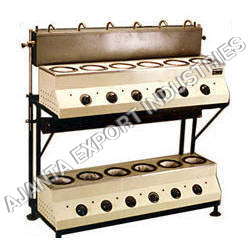
- Most suitable for all type of digestion and distillation.
- Sturdy stand structure having powder coating finish and quite heavy duty to hold complete assembly perfectly
- Two heater housing box for digestion base plate to get quick heating
- 250ml. 500ml.or 800ml. flask can be used.
- Condenser rack made of brass for water circulation in condenser.
- Fume duct pipe made if S.S for driving away fumes.
- Operates on 230 volts
| Cat. No. | Capacity Of Flask | Flask Recesse | Temp. Controller |
| AEI -44/ A | 250 MI TO 800 MI | 4 | Energy Regulator |
| AEI -45 /B | 250 MI TO800 MI | 6 | Energy Regulator |
Efficient Six-Sample ProcessingProcess up to six samples simultaneously with this Kjeldahl unit, significantly increasing laboratory throughput and productivity. Each unit supports flask volumes of 100, 200, 300, or 500 ml, making it suitable for a range of sample sizes and research requirements. The robust heater system ensures even and efficient digestion and distillation for precise nitrogen determination.
Reliable Safety and Fume ManagementStay protected during laboratory procedures with integrated safety features, such as a comprehensive fume disposal system and thermal overload protection. The apparatus uses a specially designed fume duct and collector to safely manage hazardous vapors, ensuring compliance with laboratory safety regulations and providing peace of mind for users.
Versatility and Built to LastCrafted from mild steel with an epoxy-coated finish and fitted with borosilicate glassware, the unit is engineered for durability and resistance to chemical and thermal stress. Whether used in research institutes, educational settings, or food industry labs, it reliably delivers precise results and stands up to rigorous daily use.
FAQ's of Kjeldahl Digestion And Distillation Unit :
Q: How does the Kjeldahl Digestion and Distillation Unit ensure accurate nitrogen estimation?
A: The unit features individually controlled casting heaters with nichrome wire and energy regulators, allowing precise temperature management for each flask. This setup enables 1% accuracy in nitrogen determination, ensuring reliable and reproducible results.
Q: What is the sample capacity and compatible flask volume of the unit?
A: This model processes up to six samples simultaneously, supporting flask volumes of 100, 200, 300, and 500 ml. Custom capacities are also available upon request to meet unique laboratory needs.
Q: When should the fume removal system be employed during operation?
A: The fume removal system should be activated whenever digestion or distillation is in process. This ensures the safe extraction and collection of hazardous gases produced, minimizing exposure risks for operators.
Q: Where is this unit typically installed in a laboratory setting?
A: Designed as a table-top unit, it fits conveniently on standard laboratory benches. Its sturdy construction and compact size-measuring 680 x 355 x 690 mm-make it suitable for use in various laboratory environments, including universities, research facilities, and industrial labs.
Q: What is the recommended process for using this equipment to determine organic nitrogen?
A: Begin by preparing your samples and placing them into the appropriate flasks. Enable the heaters and adjust each energy regulator based on the required temperature. Use the water circulation condenser and fume removal system throughout to ensure safe and complete digestion and distillation, following your standard Kjeldahl procedure.
Q: How can users benefit from the unit's safety features?
A: Operators benefit from integrated thermal overload protection, which prevents accidental overheating, and a dedicated fume disposal system that extracts and collects hazardous vapors. These safeguards enhance user safety and help maintain a compliant laboratory environment.
Q: What are the main usage areas and applications for this unit?
A: The Kjeldahl Digestion and Distillation Unit is extensively used in laboratories for determining organic nitrogen content in samples, which is essential in food analysis, environmental testing, agricultural research, and academic studies.







 English
 Spanish
 French
 German
 Italian
 Chinese (Simplified)
 Japanese
 Korean
 Arabic
 Portuguese


 Send Inquiry

