Product Description
Salient Features
| | MICROPROCESSOR CONTROLLED
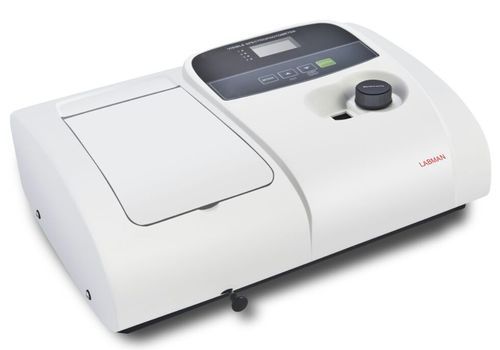
Microprocessor controlled, LMSP-V320 can realize auto Zero and auto 100% T adjustment with one push-button. LMSP-V320 has a LCD display for direct readout of Transmittance, Absorption, and Concentration. |
| | GRATING MONOCHROMATOR
LMSP-V320 uses 12000 line grating which ensures high resolution, low stray light and parameters accuracy. |
| | DATA OUTPUT
LMSP-V320 is equipped with USB port which can be connected to PC to edit data through specific software (Optional) Data can also be printed through a parallel port connected to a micro printer. |
| | COMPACT DESIGN, EASY TO CARRY
The compact design of LMSP-V320 saves bench space while all components function remain performed like 120mm wide sample compartment and long optical path monochromator. |
| | DISPLAY MODE
LMSP-V320 can display absorption, transmittance, concentration and coefficient directly by different mode switching. |
| | Large sample compartment, it can accommodate 5-100mm path length cuvettes with optional holders |
Advanced Photometric PerformanceThis spectrophotometer delivers precise results with its photometric range of 0-125% T and -0.3-3.0 A. Featuring a 5 nm bandwidth and a silicon photodiode detector, it ensures stable and accurate readings for various laboratory applications. The instrument supports absorbance, transmittance, and concentration measurement modes, making it versatile for chemical analysis and research tasks.
User-Friendly Operation and DesignEquipped with manual knob controls and a clear digital display (LED/LCD), the spectrophotometer is intuitive to operate. The device includes a 4-position cuvette holder and accepts standard 10 mm path length optical glass cuvettes. With its lightweight, compact build and powder-coated mild steel chassis, it balances durability with ease of handling.
Connectivity and Data HandlingData output is facilitated through RS232 interface or an optional USB port, allowing easy integration with laboratory computers. This enables efficient data management and seamless transfer of measurement results, supporting both routine testing and detailed research documentation.
FAQ's of Visible Spectrophotometer:
Q: How does the spectrophotometer achieve accurate wavelength selection?
A: The spectrophotometer ensures accurate wavelength selection via a user-friendly manual knob, allowing precise adjustment between 325 nm and 1000 nm. The digital display provides real-time feedback, ensuring the selected wavelength is maintained throughout the analysis.
Q: What sample types and cuvettes are supported by this instrument?
A: This model supports standard 10 mm optical glass cuvettes and is suitable for analyzing clear liquid samples. The 4-position cuvette holder enables quick and convenient analysis of multiple samples under laboratory conditions.
Q: When should calibration be performed, and what methods are available?
A: Calibration should be performed regularly or when the instrument is relocated or after significant maintenance. You can choose between automatic or manual calibration options provided by the spectrophotometer, ensuring ongoing measurement accuracy.
Q: Where is this spectrophotometer typically utilized?
A: This equipment is commonly used in chemical analysis laboratories, academic research, and industrial quality control settings across India, fostering reliable results in environmental, pharmaceutical, and educational applications.
Q: What is the process for measuring sample absorbance or transmittance?
A: To measure absorbance or transmittance, insert your sample into a compatible 10 mm cuvette, place it in the holder, select the desired wavelength and measurement mode, and initiate the reading using the user-friendly controls. Results are displayed digitally and can be exported for documentation.
Q: How can users benefit from its digital display and connectivity options?
A: The digital LED/LCD display enhances data visibility and accuracy, while RS232/USB connectivity streamlines result transfer, supporting efficient data handling and reporting in professional laboratory environments.
Q: What operating conditions and safety considerations should be observed?
A: Ensure the instrument is operated within 10C to 40C and stored between -20C to 60C with relative humidity below 80% (non-condensing). Its durable powder-coated body and user-friendly controls are designed for safe, everyday laboratory use.







 English
 Spanish
 French
 German
 Italian
 Chinese (Simplified)
 Japanese
 Korean
 Arabic
 Portuguese


 Send Inquiry

