Product Description
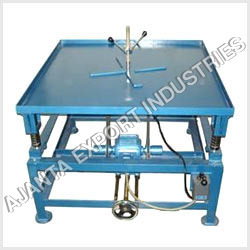
Ever since the establishment of the firm, we are engaged in providing the customers with quality-approved & perfectly designed Vibrating Tables. Offered array is manufactured under the vigil of expert professionals by utilizing superior-grade raw material, modern machinery and advanced techniques. Widely used for compacting cylinders & concrete cubes, the range can be availed in a plethora of sizes & configurations.
Specifications:
- Designed to carry 140 kg load
- Switches for starting the motor
- Speed regulation handles for increasing/decreasing frequency
- Suitable for operation on 440 volts, 3 phase, 50 cycles, A. C. supply
- Consist of a motor fitted with variable pitch pulley housed in a cabinet
- Vibrations imparted by means of off-balance mass rotating on a shaft of vibrator clamped to the underside of table top of 50 cm x 50 cm dimension
- This prevents molds from walking off during vibration
- Provided with an adjustable cross arm on a vertical rod at the center of the table for holding the molds
- Variable pitch pulley arrangement for permitting variable frequency between a maximum of 3600 vibrations per minute
Top sizes for vibrating tables:
- 75 cm x 75 cm
- 100 cm x 100 cm
Advanced Industrial Vibration TechnologyOur vibrating tables utilize high-quality motors with power options between 0.5 and 2 HP, ensuring optimal frequency and force for effective compaction and settling operations. The tables are available with either mild steel or stainless steel tops and are finished with powder coating for enhanced durability, resisting corrosion and wear over time, especially in demanding industrial environments.
Versatile Applications and Flexible OperationDesigned for various industrial processes, these vibrating tables support both automatic and semi-automatic operation. Manual controls allow users to precisely manage the vibration process. Thanks to the flexible power input (220-415 V) and compatibility with both single and three-phase systems, these tables can be seamlessly integrated into existing industrial setups, maximizing productivity and consistency.
FAQ's of Vibrating Tables:
Q: How do I operate the vibrating table for industrial applications?
A: These vibrating tables are straightforward to operate manually, with options available for automatic and semi-automatic modes. Simply connect the table to a power source (220-415 V, single or three-phase), adjust your settings according to your process needs, and initiate vibration using the control panel.
Q: What materials are used in the construction of these vibrating tables?
A: Our vibrating tables are built primarily from mild steel, with the option for stainless steel table tops. The entire surface is powder coated for extra protection against rust and abrasion, ensuring long service life in industrial conditions.
Q: When should I use a vibrating table with higher motor power?
A: Tables with higher motor power (closer to 2 HP) should be used when handling heavier loads or dense materials that require robust vibration for effective compaction or settling. Select the motor power based on the weight and type of material you plan to process.
Q: Where can I purchase these vibrating tables in India?
A: These vibrating tables are available from reputable distributors, exporters, manufacturers, suppliers, and traders throughout India. You can contact your preferred industrial equipment supplier for more details or to place an order.
Q: What is the typical process for using a vibrating table in an industrial setting?
A: Place the material or mold on the table, set your desired vibration frequency, and start the operation. The vibration helps in removing air bubbles, compacting materials, or settling particles, depending on your specific industrial requirement.
Q: How does using a vibrating table benefit industrial production?
A: Employing a vibrating table enhances product consistency by ensuring uniform compaction or particle distribution. This improves final product quality and reduces waste, streamlining your production process and saving on material costs.







 English
 Spanish
 French
 German
 Italian
 Chinese (Simplified)
 Japanese
 Korean
 Arabic
 Portuguese


 Send Inquiry

