Product Description
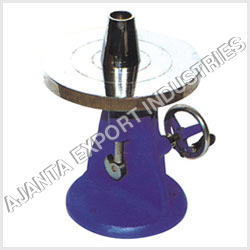
Capitalizing in our in-depth industry knowledge, we have been able to provide the customers with highly advanced Cement Testing Flow Tables. Designed in line with the universally accepted quality standards, our range is widely used for determining workability of building limes.
Acknowledged for high operational accuracy and reliability, the range consists of the following:
- Height of the mold 90 mm
- Polished steel plate of 30 cm diameter with 3 annular circles engraved on it with diameters of 7, 11 and 19 cm
- Table top is arranged for a free fall of 12.5 mm by a cam action
- One brass conical mold of 65 mm at the base and 40 mm at the top
Engineered for Precision and DurabilityFeaturing a sturdy cast iron table and rigid steel frame, this cement flow table guarantees stability and reliability during laboratory testing. The gear-driven mechanical operating system ensures consistent performance. Its smooth machining finish provides precise test surfaces, making it an essential tool for accurate measurement and repeatable results in cement analysis.
Comprehensive Accessory SetEach flow table includes a tamper, spatula, and a brass, conical flow mold, ensuring you have all necessary components for complete testing procedures. The included mechanical counter records the number of drops, further supporting standardized and reproducible results.
Certified Quality and Versatile ApplicationThis flow table conforms to IS 5512 and ASTM C230 standards for cement testing, assuring compliance with international and Indian protocols. The equipment is suitable for laboratory use in research, quality control, and manufacturing environments across various sectors of the cement industry.
FAQ's of Cement Testing Flow Tables:
Q: How is the Cement Testing Flow Table operated during laboratory tests?
A: The flow table uses a manual, gear-driven mechanical drive. You use the provided hand wheel to control the vertical movement of the table, ensuring each drop is consistent, with a mechanical counter tracking the number of drops during testing.
Q: What materials make up the principal components of the flow table and mold?
A: The main table is manufactured from cast iron for durability and stability, while the flow mold is crafted from brass. The frame is rigid steel, and other accessories like the tamper and spatula are made of stainless steel.
Q: When should I use a flow table for cement testing?
A: Use the flow table during quality assessment or research in laboratories whenever you need to determine the workability and flow characteristics of cement, following IS 5512 or ASTM C230 standards.
Q: Where is this cement flow table commonly used?
A: It is used in laboratory environments, such as those found in cement factories, quality control labs, research institutions, and academic facilities throughout India and in organizations conforming to international standards.
Q: What process does the cement flow table measure and help analyze?
A: The table assesses the flow properties and consistency of cement paste by recording its spread after a specified number of table drops, providing crucial data for compliance and performance evaluation.
Q: How does using this flow table benefit cement testing laboratories?
A: It ensures standardized and reliable results, increases testing efficiency, and aids in meeting international and Indian quality standards, which helps maintain product reliability and supports research activities.







 English
 Spanish
 French
 German
 Italian
 Chinese (Simplified)
 Japanese
 Korean
 Arabic
 Portuguese



 Send Inquiry

