Product Description
Description:
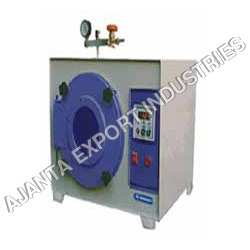
Vacuum ovens are commonly using the temp range from 50 C to 200 C. The inner chamber is made out of stainless steel and outer of MS sheet beautifully powder coated, glass wool insulation is provided all around the chamber to minimize heat loss due to radiation. The door is provided with a glass window to view the samples placed inside. The temperature is controlled and indicated by a provided. Maximum vacuum: 760 mm of Hg. Mains 220 230 V.AC
(a) Round
| Size |
9dia*12depth |
12dia*15depth |
15dia*18depth |
(b)Rectangular
Working Chamber
L * W * D | No. of
Shelves |
8 x8x12 | 2 |
12x12x16 | 2 |
14x14x20 | 3 |
18x18x30 | 3 |
20x20x30 | 4 |
Achieve highly accurate results with this vacuum oven's digital temperature controller, maintaining settings within 1C. Concealed heating elements promote uniform temperature distribution throughout the stainless steel inner chamber, making it ideal for sensitive drying and degassing tasks in laboratory and industrial settings.
Enhanced Safety and DurabilitySafety is integral, with integrated over-temperature protection and fuse safeguards. The leak-proof silicone gasket and toughened glass window ensure operational safety and longevity. Its powder-coated outer body and stainless steel surfaces provide resistance to chemical corrosion and physical wear, sustaining lasting performance.
FAQ's of Vacuum Ovens Electric:
Q: How does the electric vacuum oven maintain uniform temperature during operation?
A: The oven is equipped with concealed heating elements and a glass wool-insulated chamber, ensuring even heat distribution. Combined with the digital temperature controller, the system consistently maintains your set temperature within an accuracy of 1C, crucial for delicate laboratory or industrial drying.
Q: What are the key safety features of this vacuum oven?
A: This vacuum oven is built with over-temperature protection and fuse protection mechanisms to prevent overheating and electrical faults. The front opening door has a toughened glass window and a leak-proof silicone gasket, ensuring safe operation during vacuum processing.
Q: When should I use a vacuum oven instead of a conventional drying oven?
A: Vacuum ovens are ideal for applications that require solvent removal, low-temperature drying, or preventing oxidation-such as in pharmaceutical, research, and industrial material preparation. Use it whenever controlled, gentle drying and reduced atmospheric pressure are needed for sensitive samples.
Q: Where can this vacuum oven be installed and who typically uses it?
A: Designed for laboratory, research, pharmaceutical, and industrial settings, this oven can be installed on stable laboratory benches with standard single-phase 230V AC supply. It is commonly used by scientists, lab technicians, and industrial researchers across India.
Q: What is the process for setting up and using the vacuum oven?
A: After positioning the oven and connecting it to a suitable power supply, place your samples on the adjustable stainless steel shelves. Close the door firmly, ensuring the silicone gasket is seated, set your required temperature on the digital controller, and activate the vacuum pump as needed. Regularly monitor via the digital display and vacuum gauge.
Q: What benefits do the adjustable shelves and glass wool insulation provide?
A: The two adjustable stainless steel shelves offer flexibility to accommodate various sample sizes, making it versatile for multiple applications. Glass wool insulation minimizes heat loss, enhances energy efficiency, and helps maintain stable internal temperatures for consistent drying performance.







 English
 Spanish
 French
 German
 Italian
 Chinese (Simplified)
 Japanese
 Korean
 Arabic
 Portuguese


 Send Inquiry

