Product Description
Salient Features
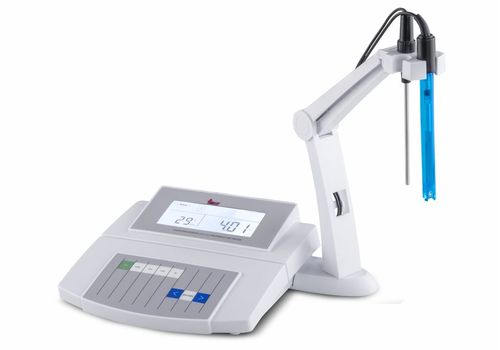
| | Large backlit LCD display shows mode indicators and help messages. |
| | Up to 3 points push-button calibration with auto-buffer recognition. |
| | Selectable pH buffer standards and temperature units. |
| | Automatically calculates and displays electrode slope after calibration. |
| | Automatic Temperature Compensation (ATC) ensures highly accurate measurements over the entire range. |
| | Automatic endpoint function freezes the stable measured values |
| | Help message as a operational guide to helps you understand how to use meter. |
| | Setup menu lets user customizes buffer standards, calibration points, temperature units, automatic or manual hold function, auto-off feature to meet personal preferences. |
| | Reset function can resumes all settings to factory default values | Range | -2.00 to 16.00 pH | | | pH Resolution | 0.01 | | | Accuracy | ± 0.01pH | | | Calibration Points | up to3 points | | | | | mV Range | +1999 mV | | | Accuracy | ± 1 mV | | | Resolution | 1mV | | | | | Range | 0 to 105°C | | | Accuracy | ± 0.5°C | | | Resolution | 0.1°C | | | Temperature Compensation | 0~100°C, Manual / Automatic | | | | | Hold Function | Available | | | Auto Off Function | Available | | | Connector | BNC | | | Display | LCD (135× 75mm) | | | Power Requirements | DC9V, using AC adapters, 220VAC/50Hz | | | Dimensions ( Lx W x H) | 210 × 205 × 75 mm | | | Packing Box Size | 300 x 250 x 175 mm | | | Weight | 1.5 kg | | |
Exceptional Measurement PrecisionThis digital benchtop meter offers an outstanding degree of accuracy: 0.01 pH, 1 mV, and 0.5C. The auto calibration and automatic buffer recognition features make setup swift and error-free, benefiting laboratory personnel who require dependable readings for vital analyses.
User-Friendly OperationEquipped with a large backlit LCD and intuitive controls, the meter facilitates efficient workflows in laboratory environments. The microprocessor-based system supports automatic temperature compensation and a data hold function, enabling precise monitoring and documentation of results. Calibration can be performed up to five points, enhancing reliability in varying sample conditions.
Versatile Laboratory ApplicationWith a wide range and high-resolution measurement capability, this instrument is suitable for diverse laboratory tasks, from routine pH monitoring to complex research applications. Its compatibility with pH electrodes via BNC and temperature probes via RCA connectors, and compliance with CE standards, make it a preferred choice for quality lab operations in India.
FAQ's of Benchtop pH / mV /A C Meter:
Q: How do I calibrate the Benchtop pH / mV / C Meter?
A: Calibration is simple and can be performed using up to five points for maximum accuracy. Use the meter's automatic buffer recognition during calibration, and follow on-screen prompts displayed on the large backlit LCD. Regular calibration is recommended to maintain measurement reliability.
Q: What types of samples can this instrument measure?
A: The meter is designed for laboratory analysis of aqueous samples. It accurately measures pH, millivoltage, and temperature in liquids, making it ideal for testing water quality, laboratory research, and educational experiments.
Q: Where should the meter be installed for optimal use?
A: Install the device on a stable benchtop in a laboratory setting. Ensure ambient storage and operation temperatures are within -10C to 60C, at less than 80% relative humidity, to preserve its performance and lifespan.
Q: What are the main benefits of using this digital benchtop meter?
A: This meter provides automatic temperature compensation, multiple calibration points, and high accuracy. Its robust design, user-friendly display, and GLP compliance all contribute to improved efficiency, reliability, and data integrity in laboratory workflows.
Q: When is it necessary to recalibrate the meter?
A: Recalibration is recommended before critical measurements, after electrode replacement, or if the instrument has been idle for an extended period. This ensures continued precision and compliance with laboratory standards.
Q: How do I connect the electrodes and probes to the device?
A: Connect the pH electrode using the BNC input connector and the temperature probe using the RCA connector. The meter's design accommodates these standard connectors to ensure secure and reliable measurements every use.







 English
 Spanish
 French
 German
 Italian
 Chinese (Simplified)
 Japanese
 Korean
 Arabic
 Portuguese


 Send Inquiry

